Need a Technical Advice?

Optisch gesteuertes 40-Tonnen-Schwerlast-FTS für die Logistik von Industriekomponenten in Italien

Client Overview

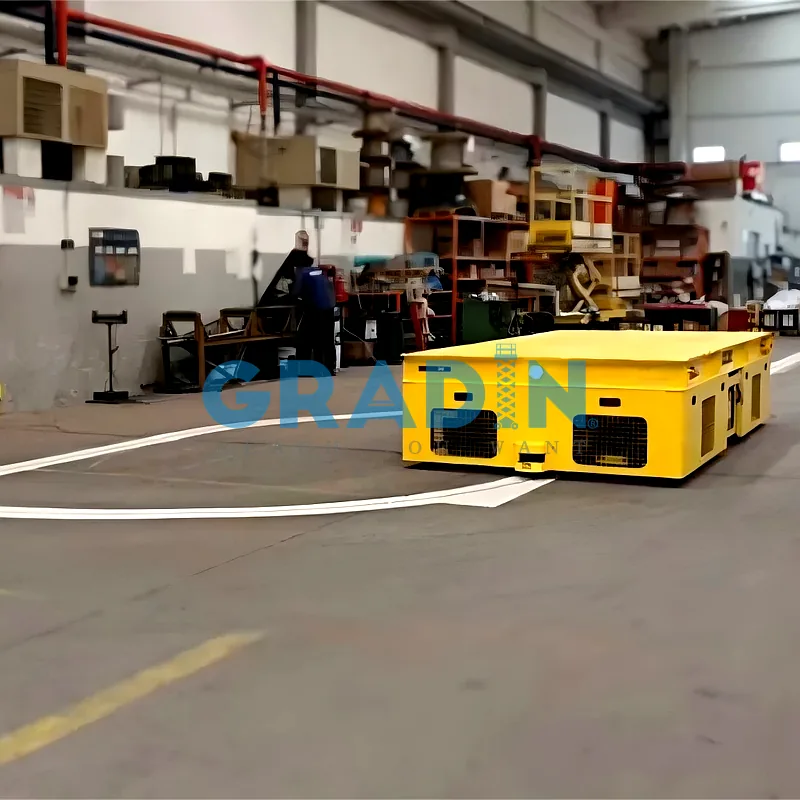
This project involved the deployment of a 40-ton heavy-duty Automated Guided Vehicle (AGV) at a specialized mechanical engineering facility in Turin, Italy. The facility, situated in a major European automotive and aerospace hub, required an autonomous solution for the cross-bay transport of oversized engine blocks and structural steel assemblies between the machining center and the final assembly line.

The primary technical objective was to transition from overhead crane-based logistics to a floor-based autonomous system to increase plant flexibility and reduce crane-wait times. This Internal Link: heavy-duty AGV transport vehicle utilized high-precision optical guidance technology to navigate a 120-meter transit path. The system was engineered to comply with the ISO 3691-4:2020 safety requirements for driverless industrial trucks and local Italian workplace safety mandates (CE certification), ensuring seamless integration into a high-traffic manufacturing environment.

Challenge & Solution

Client Challenges

The Turin facility presented a dense operational landscape where traditional magnetic tape or laser navigation faced significant environmental and logistical hurdles.

  • Dynamic Center of Gravity (CoG) for 40-Ton Loads: Transporting 40,000 kg structural components involves extreme inertial forces. Any sudden acceleration or deceleration in the  automated guided vehicle could lead to load shifting or floor damage.

  • Navigation Reliability in Metallic Environments: The facility’s high concentration of steel infrastructure and electromagnetic interference from heavy welding stations rendered standard magnetic and some early-stage wireless navigation systems unreliable.

  • Spatial and Turning Radius Constraints: The transit path included several 90-degree turns within narrow corridors. A 40-ton vehicle requires a sophisticated multi-wheel steering geometry to maintain a tight turning radius without scuffing the industrial floor coating.

  • Safety in Manned Work Zones: The AGV must operate in zones where human technicians and manual forklifts are present. The challenge was to ensure 360-degree obstacle detection that could distinguish between static infrastructure and dynamic human movement at high payloads.

  • Floor Loading and Surface Pressure: Distributing a 40-ton static load plus the vehicle’s self-weight (approx. 8 tons) required a specialized multi-axle wheel configuration to ensure the heavy-duty transporter did not exceed the local floor pressure limit of 10 N/mm².

GRADIN Custom Solution

To address the logistical requirements of the Turin plant, a customized AGV-40T-OPT-ITA was developed, focusing on optical path-following stability and high-capacity structural redundancy.

Parameter Specification
Nennbelastbarkeit 40,000 kg (40 Metric Tons)
Guidance System High-Precision Optical (Line Following)
Navigationsgenauigkeit ± 10 mm
Stop Accuracy ± 5 mm
Travel Speed (Full Load) 0.2 – 0.5 m/s (Adjustable)
Steering Type Multi-Axle Independent Steering
Dimensions (LxWxH) 5,200 mm x 2,800 mm x 850 mm
Sicherheitssensoren 2x SICK microScan3 (360° Coverage)
Power Source LiFePO4 48V/400Ah Battery
Kontrollierte Architektur PLC-based with Wi-Fi 6 WMS Interface
Min. Turning Radius 3,500 mm (Pivot Turn Capable)
Compliance CE / ISO 3691-4 / EN 1175

1. Optical Guidance and Path-Following Precision
The vehicle utilizes a high-resolution optical guidance sensor system that tracks a high-contrast white line applied to the floor. Unlike magnetic tape, this optical solution is immune to electromagnetic interference and offers a lower maintenance profile in heavy-metal environments. The onboard navigation controller executes real-time path correction with a tracking accuracy of ±10mm, ensuring the vehicle maintains its trajectory even under maximum 40-ton loading.

2. Multi-Axle Power-Steering and Load Distribution
The chassis is engineered with an 8-wheel configuration, utilizing high-density polyurethane vulcanized tires. Four of these wheels are independent drive-steer units, managed by a synchronized PLC-based motion control architecture. This allows the 40-ton AGV to execute “crab-steering” and “spin-turns,” significantly reducing the required operational footprint and distributing the load evenly to protect the facility floor.

3. Advanced Safety Scanning and Obstacle Avoidance
For human-machine collaboration safety, the vehicle is equipped with dual SICK microScan3 safety laser scanners mounted on diagonal corners. This provides a 360-degree safety field that is dynamically adjusted based on the vehicle’s speed and load weight. If an obstacle is detected within the “Warning Zone,” the AGV automatically modulates its speed; if the “Safety Zone” is breached, the Internal Link: heavy-duty AGV executes a controlled emergency stop within 150ms.

4. Energy Management and WMS Integration
The transporter is powered by a high-capacity Lithium Iron Phosphate (LiFePO4) battery array, optimized for 16 hours of continuous operation. The system integrates with the factory’s Warehouse Management System (WMS) via a secure Wi-Fi 6 gateway, allowing for automated dispatching, real-time status reporting, and predictive maintenance diagnostics.

Technical Parameters & Supporting Brands

Technical Parameters

Parameter Specification
Nennbelastbarkeit 40,000 kg (40 Metric Tons)
Guidance System High-Precision Optical (Line Following)
Navigationsgenauigkeit ± 10 mm
Stop Accuracy ± 5 mm
Travel Speed (Full Load) 0.2 – 0.5 m/s (Adjustable)
Steering Type Multi-Axle Independent Steering
Dimensions (LxWxH) 5,200 mm x 2,800 mm x 850 mm
Sicherheitssensoren 2x SICK microScan3 (360° Coverage)
Power Source LiFePO4 48V/400Ah Battery
Kontrollierte Architektur PLC-based with Wi-Fi 6 WMS Interface
Min. Turning Radius 3,500 mm (Pivot Turn Capable)
Compliance CE / ISO 3691-4 / EN 1175

Supporting Brands

Our tilting machines adopt premium imported and domestic brand components for electric control, pneumatic, hydraulic and mechanical parts.
1. Electric Control Components
Quality parts ensure precise and stable operation
•SIEMENS: PLC, inverter, low-voltage parts
•MITSUBISHI: Servo motors and drive systems
2. Pneumatic & Hydraulic Components
Guarantee steady flipping and high load capacity
•SMC: Cylinders and pneumatic accessories
•REXROTH: Hydraulic valves and pump stations
3. Mechanical Transmission Parts
Solid structure enables smooth running
•HIWIN: Linear guides and screw assemblies
•NSK: High precision rotating bearings
4. Low Voltage Distribution Parts
•CHINT/DELIXI: Circuit breakers and switches
•EATON: Safety and distribution components

Project Execution & Achievements

Implementation Details

Execution & Achievements

1. Optical Guidance and Path-Following Precision
The vehicle utilizes a high-resolution optical guidance sensor system that tracks a high-contrast white line applied to the floor. Unlike magnetic tape, this optical solution is immune to electromagnetic interference and offers a lower maintenance profile in heavy-metal environments. The onboard navigation controller executes real-time path correction with a tracking accuracy of ±10mm, ensuring the vehicle maintains its trajectory even under maximum 40-ton loading.

2. Multi-Axle Power-Steering and Load Distribution
The chassis is engineered with an 8-wheel configuration, utilizing high-density polyurethane vulcanized tires. Four of these wheels are independent drive-steer units, managed by a synchronized PLC-based motion control architecture. This allows the 40-ton AGV to execute “crab-steering” and “spin-turns,” significantly reducing the required operational footprint and distributing the load evenly to protect the facility floor.

3. Advanced Safety Scanning and Obstacle Avoidance
For human-machine collaboration safety, the vehicle is equipped with dual SICK microScan3 safety laser scanners mounted on diagonal corners. This provides a 360-degree safety field that is dynamically adjusted based on the vehicle’s speed and load weight. If an obstacle is detected within the “Warning Zone,” the AGV automatically modulates its speed; if the “Safety Zone” is breached, the Internal Link: heavy-duty AGV executes a controlled emergency stop within 150ms.

4. Energy Management and WMS Integration
The transporter is powered by a high-capacity Lithium Iron Phosphate (LiFePO4) battery array, optimized for 16 hours of continuous operation. The system integrates with the factory’s Warehouse Management System (WMS) via a secure Wi-Fi 6 gateway, allowing for automated dispatching, real-time status reporting, and predictive maintenance diagnostics.

Empfohlene Ausrüstung

Vertikale Hebebühne für Montageplätze nach Maß - Modulare höhenverstellbare Plattform

Personalhebebühne für die Lokomotivmontage - Wartungsbühne für Eisenbahnmotoren

Hebebühne für die Montage von Großgeräten in der Luftfahrt - Hochpräzise Hebebühne für die Luft- und Raumfahrt

Vier-Säulen-Hebebühne mit Motorschraube - Mechanische Synchron-Viersäulen-Hebebühne