


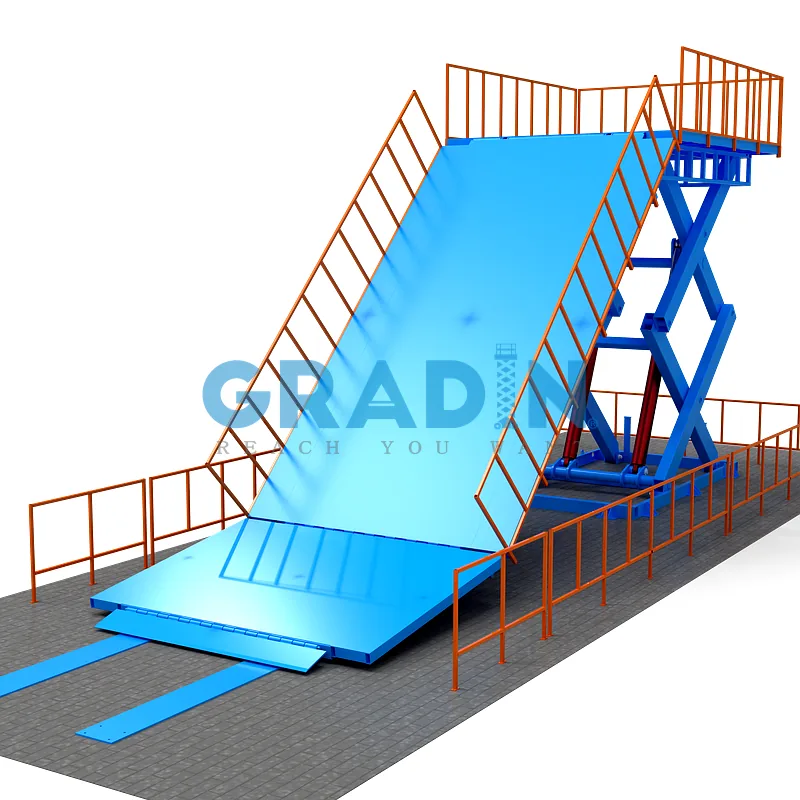
A dock lift (loading dock lift) is a heavy-duty hydraulic scissor lifting platform built to transfer pallets, goods and wheeled cargo between ground level and variable truck bed heights. Unlike dock levelers which only bridge a small height gap on a fixed raised dock, dock lifts deliver full vertical travel, making them the ideal loading solution for sites with no permanent loading dock, or fleets with mixed truck and container heights. It is widely used in warehouses, factories and logistics terminals for forklift and pallet jack loading operations.
Dock Lift vs Dock Leveler vs Standard Scissor Lift
| Item | Dock Lift | Dock Leveler | Standard Scissor Lift Table |
|---|---|---|---|
| Core Function | Vertical lifting between ground and truck bed | Bridge small height difference on fixed dock | General in-plant lifting |
| Vertical Travel | Wide range, 800–1800 mm typical | Limited ±250~300 mm | Variable |
| Fixed dock required? | No | Yes | No |
| Folding lip bridge | Standard | Standard | Usually no |
| Main use | No-dock loading, mixed truck heights | Standard dock high-volume loading | Workshop lifting, assembly |
Main Types of Dock Lifts
- Pit-Mounted Dock Lift Installed inside a pre-cast concrete pit. When fully lowered, its deck sits flush with the floor. Clean, space-saving, suitable for frequent forklift rolling traffic. Most popular for permanent warehouse loading zones.
- Surface-Mounted / Pitless Dock Lift Placed directly on flat concrete ground, no excavation needed. Equipped with access ramps. Perfect for rented buildings, temporary yards or retrofits where digging pits is not allowed.
- Mobile Dock Lift Fitted with wheels and tow points. Can be moved between loading bays. Great for multi-bay, low-frequency loading work.
- Heavy-Duty Forklift-Rated Dock Lift Reinforced deck and scissor frame with high edge-load rating, designed for full forklift driving on the platform, not just pallet trucks.
- Special Custom Versions Stainless steel washdown for food processing; explosion-proof for chemical plants; low-profile models for limited overhead clearance.
Core Technical Parameters
All dimensions and capacities can be customized:
| Parameter | Standard Range | Custom Options |
|---|---|---|
| Rated Load Capacity | 2000 kg, 3000 kg, 5000 kg, 6000 kg | Up to 10 ton heavy-duty |
| Lifting Travel | 800 mm – 1800 mm | Up to 2000 mm for high-bed trailers |
| Platform Size | 2000×1800 mm, 2500×2000 mm, 3000×2200 mm | Extended deck for full forklift entry |
| Folding Lip Length | 400 mm standard | 500 mm extended lip for deep containers |
| Lifting Speed | 0.1–0.15 m/s | Slow speed option for fragile cargo |
| Drive System | Double scissor hydraulic | Single scissor for light load |
| Power Supply | 380V 3-phase 50Hz | 220V single-phase, 440V / 480V for overseas |
| Control | Dead-man push button | Optional PLC + remote control, automatic cycle |
| Deck Surface | Anti-slip checker plate | Galvanized, stainless steel |
Standard Safety Configurations (CE / EN1570 / ISO 14122 compliant)
- Hydraulic burst / rupture valve: locks platform instantly if hose breaks
- Safety toe guard / trip edge: stops lowering when hitting obstacles
- Mechanical maintenance props: lock platform up for safe under-deck service
- Emergency stop button + dead-man control (only runs while button held)
- Top & bottom limit switches
- Non-slip textured deck, safety warning marking
- Optional guardrails, audible & visual motion alarm, perimeter safety light curtain
Key Advantages
Works without a fixed loading dock, saves civil construction cost
Adapts to different truck heights: vans, box trucks, semi-trailers, sea containers
Can handle full forklift loading when heavy-duty version is specified
Pitless surface type can be installed quickly in 1–2 days
Stable scissor structure, low noise, easy daily maintenance
Limitations
Slower cycle speed than dock levelers for continuous high-volume loading
Forklift-rated units must be selected carefully; normal pallet-jack dock lifts cannot support full forklift weight
Requires flat, solid concrete foundation with enough floor load capacity
Typical Application Industries
- Manufacturing plants without built-in loading bays
- Small & mid-sized warehouses, 3PL logistics distribution centers
- Food, beverage and cold storage facilities
- Retail, e-commerce fulfillment yards
- Freight terminals, container yards and temporary loading zones
Selection Checklist Before Ordering
- Calculate total load: cargo + pallet + pallet jack / forklift weight, add 20% safety margin. Never only calculate goods weight.
- Confirm maximum truck bed height to define required lifting travel.
- Decide loading equipment: pallet truck only, or full forklift drive-on (critical for edge load rating).
- Choose installation type: pit-mounted or pitless surface mount.
- Check foundation concrete strength and available overhead clearance.
- Confirm environment: wet washdown, corrosive or explosive atmosphere.
FAQ
Q1: What is the biggest difference between dock lift and dock leveler? A: A dock leveler is installed on an existing raised dock and only compensates small height differences. A dock lift lifts the whole platform from ground up to trailer height; it replaces the dock itself.
Q2: Can a forklift drive onto the dock lift? A: Only if it is explicitly forklift-rated heavy-duty dock lift. Standard pallet-jack dock lifts are not designed for concentrated axle load from forklifts and will be damaged.
Q3: Can I install a dock lift if I cannot dig a pit? A: Yes. Surface-mounted pitless dock lifts with side access ramps are designed for this scenario.
Q4: What happens when power fails? A: Standard dock lifts have a manual lowering valve. Qualified operators can slowly lower the platform safely to ground. It cannot lift without power.
Q5: How often should I maintain a hydraulic dock lift? A: Weekly visual check for leaks, loose bolts and safety edges. Quarterly full inspection of cylinders, chains, limit switches and safety props. Replace hydraulic oil every 1–2 years under regular shift operation.
Q6: What is the typical lead time? A: Standard 2–5 ton pit dock lifts: 1–2 weeks. Heavy-duty forklift-rated, stainless or explosion-proof custom units: 4–6 weeks.
Final Summary
Dock lifts are the most flexible loading solution when your site lacks a fixed loading dock or receives mixed-height vehicles. When specified correctly with proper edge-load rating and safety components, they reduce manual handling injuries and expand loading capability without expensive building renovation.

 English
 Spanish
 Portuguese
 Russian
 Arabic
 Turkish
 Thai
 Vietnamese
 Indonesian
 French
 German
 Polish
 Dutch