


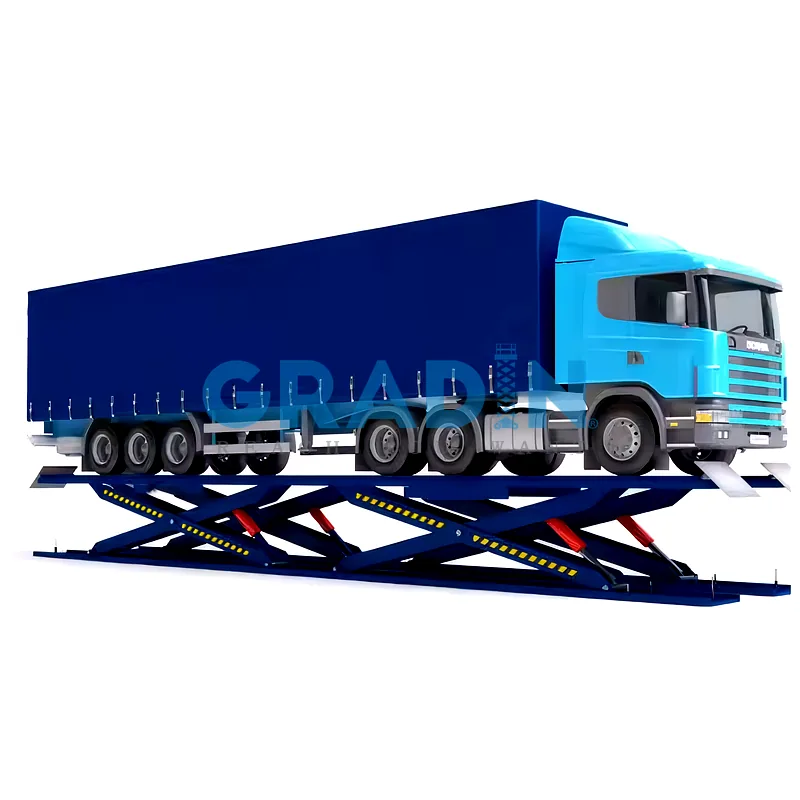
Heavy-Duty Scissor Lifts for Steel Mills, Foundries & Heavy Manufacturing
When a standard scissor lift tops out at 5 or 10 tons, heavy industry needs something built on an entirely different scale. A heavy-duty scissor lift engineered for steel mills, foundries, and large-scale manufacturing routinely handles loads from 10 tons well past 100 tons, surviving environments where ambient temperatures exceed 120 degrees F and airborne particulate is constant. This article examines what separates a true heavy-duty scissor lift from a conventional platform, the design decisions that drive long service life under extreme loads, and how facilities are deploying them to solve material handling challenges that overhead cranes alone cannot address.
What Qualifies a Scissor Lift as “Heavy-Duty”?
The term “heavy-duty” is not a marketing label in this context. It refers to a specific engineering threshold. In material handling, a heavy-duty scissor lift is generally defined by three characteristics:
- Load capacity of 10 tons (20,000 lbs) or greater. Standard industrial scissor lifts typically handle 1,000 to 10,000 lbs. Once you cross the 10-ton mark, every structural and hydraulic component must be redesigned from the ground up.
- Reinforced structural members. The scissor arms, base frame, and platform are fabricated from high-strength steel plate, often ASTM A572 Grade 50 or equivalent, with thicknesses of 1 inch or more at critical stress points.
- Industrial-duty hydraulic systems. High-flow piston cylinders, hardened rod surfaces, and fluid ratings that maintain viscosity across the operating temperature range of the facility.
A heavy-duty scissor lift from a qualified manufacturer is not an upscaled catalog product. It is a purpose-engineered machine designed around the specific load geometry, stroke requirement, and duty cycle of the application.
Applications in Steel Mills and Foundries
Ladle Handling and Tundish Positioning
In continuous casting operations, ladles weighing 40 to 150 tons must be positioned with precision measured in millimeters. A heavy-duty scissor lift serves as a tundish positioning platform or a ladle transfer station, providing stable vertical movement that overhead cranes cannot deliver with the same repeatability. Hydraulic scissor platforms in these roles often feature dual-cylinder or quad-cylinder configurations to distribute load forces evenly and provide redundancy in case of a single-cylinder seal failure.
Coil Positioning and Transfer
Furnace Maintenance Platforms
Furnace relining and inspection require workers and equipment to be raised to the furnace mouth or tapping hole area. A heavy-duty lift platform rated for 20 to 30 tons can carry refractory bricks, demolition equipment, and a crew simultaneously, providing a stable work surface that scaffolding cannot match in speed or safety.
Key Design Features of Heavy-Duty Scissor Lifts
Reinforced Scissor Arms and Pivot Points
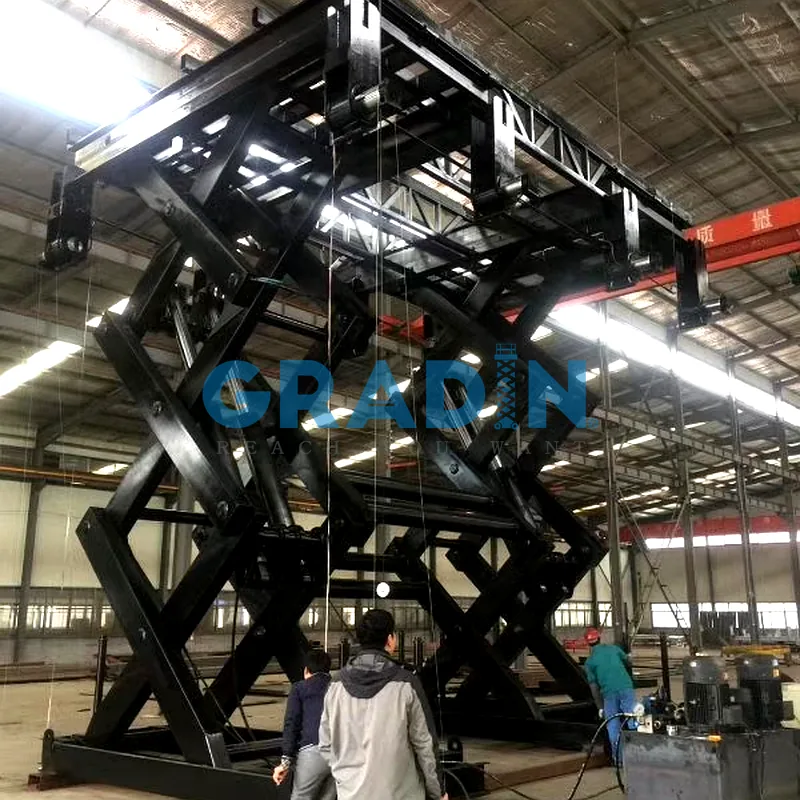
The scissor mechanism is where concentrated stress lives. On a 50-ton lift, each pivot pin endures forces exceeding 100,000 lbs at full extension. Heavy-duty designs use through-hardened alloy steel pins (typically 4140 or 4340) with diameters of 3 to 6 inches, running in replaceable bronze or hardened steel bushings. The scissor legs themselves are welded box-section or I-beam construction, with gusseting at the pivot intersections to resist torsional deflection.
High-Flow Hydraulic Systems
Lifting 50 tons through a 6-foot stroke in a reasonable cycle time (typically 30 to 60 seconds) demands substantial hydraulic flow. Systems commonly operate at 2,500 to 3,000 PSI with pump capacities of 15 to 40 GPM. Key features include:
- Counterbalance valves on every cylinder to prevent uncontrolled descent if a hose fails.
- Pilot-operated check valves that lock the cylinders in position when the platform is stationary, preventing drift.
- Duplex or triplex cylinder arrangements that share the load and provide fail-safe redundancy.
- High-temperature hydraulic fluid (such as phosphate ester or high-VI mineral oil) for environments near furnaces or casting areas.
Hardened Wear Surfaces
In a steel mill, abrasive dust settles on every exposed surface. Cylinder rods are often chrome-plated or equipped with bellows boots. Platform decks feature replaceable wear plates or diamond-tread floor plate rated for forklift traffic. Slide blocks at the scissor arm endpoints are fabricated from self-lubricating bronze or UHMW polyethylene to reduce maintenance intervals.
Custom Configurations for Specific Tasks
No two heavy-duty applications are identical. Common customizations include:
- Multi-stage scissor mechanisms for lifts requiring a high ratio of extended height to collapsed height, such as a platform that must lower to 12 inches for pit-level loading but extend to 8 feet.
- Tilt-top platforms that combine vertical lift with angular positioning, useful for pouring operations or part inspection.
- Integrated conveyors or roller tops built into the lift platform to allow lateral transfer of material at the elevated position.
- Explosion-proof or high-temperature packages for use in areas with combustible dust or radiant heat, including intrinsically safe electrical components and heat shields on hydraulic lines.
Safety Systems for Heavy-Duty Operation
A 50-ton platform descending uncontrolled is catastrophic. Safety systems on heavy-duty scissor lifts go well beyond the basics found on lighter equipment:
Mechanical Locking Bars
Many heavy-duty lifts include mechanical locking bars or safety props that physically prevent the platform from lowering when engaged. These are required by OSHA when personnel work beneath or on the platform during maintenance.
Dual Redundant Hydraulic Circuits
On critical lifts, the hydraulic system is split into two independent circuits, each capable of supporting the full load independently. If one circuit loses pressure, the other holds the platform and completes the cycle.
Load Monitoring and Overload Protection
Pressure transducers on each cylinder provide real-time load data to the PLC. If the system detects an asymmetric load exceeding the design envelope or a total load above the rated capacity, it halts operation and triggers an alarm. Some systems display live weight on an HMI panel so operators can verify load before initiating a lift cycle.
Perimeter Guarding and Interlocks
For lifts that elevate personnel, OSHA 1910.23 and ANSI/ITSDF B56.10 require guardrails, toe boards, and gate interlocks that prevent platform movement if a gate is open. Heavy-duty lifts in steel mills often integrate with the facility’s lockout/tagout system through hardwired safety relays.
Case Study Examples
Coil Upender at a Rolling Mill
A Midwest rolling mill replaced a crane-dependent coil flipping process with a 40-ton hydraulic upender built on a heavy-duty scissor base. The new system reduced coil handling time from 12 minutes to under 3 minutes per coil and eliminated two overhead crane operators from the task. Annual throughput increased by approximately 8,000 coils.
Furnace Charging Platform
An aluminum smelter installed a 25-ton scissor lift as a furnace charging platform. The lift raises scrap charge buckets from floor level to the furnace door sill height, replacing a two-crane tandem lift that required a dedicated spotter. The lift’s mechanical locks and interlocked gates reduced near-miss incidents to zero in the first year of operation.
Assembly Line Positioner
A heavy equipment manufacturer uses a pair of synchronized 15-ton scissor lifts to raise and lower large fabrications through a multi-station assembly line. The lifts operate on a common hydraulic power unit and are controlled by a single PLC, maintaining platform synchronization within 1/8 inch across a 20-foot span.
Choosing the Right Manufacturer
A heavy-duty scissor lift is a capital investment that must perform reliably for 15 to 25 years in punishing conditions. When evaluating suppliers, prioritize:
- In-house engineering and FEA analysis to validate structural design before fabrication.
- Full-scale load testing at 125 percent of rated capacity prior to shipment, with documented test reports.
- Availability of spare parts including replacement bushings, seals, and cylinder assemblies for the life of the equipment.
- Site installation supervision and operator training, particularly for lifts integrated into existing production lines.

 English
 Spanish
 Portuguese
 Russian
 Arabic
 Turkish
 Thai
 Vietnamese
 Indonesian
 French
 German
 Polish
 Dutch