What Is a Synchronized Multi-Span Scissor Lift?
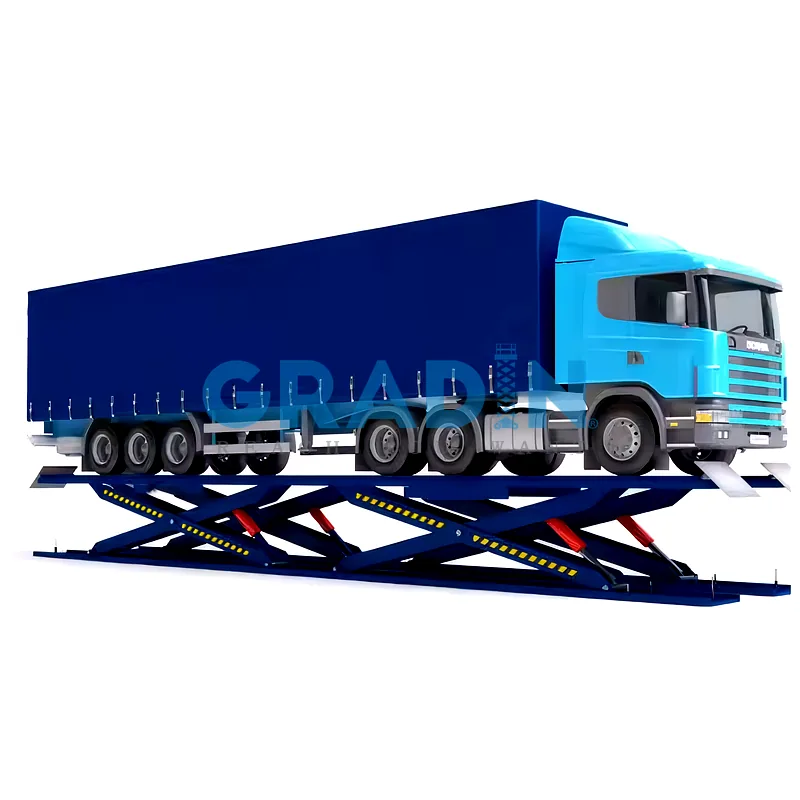
A multi-span scissor lift platform (also known as tandem synchronized scissor lift) is a custom heavy-duty hydraulic lifting system composed of two or more independent scissor units arranged in series under one continuous long deck. Unlike standard single-scissor lift tables with limited platform length, multi-span designs are built specifically to accommodate
extra-long, elongated loads that cannot fit on conventional scissor lifts.Every scissor unit is fitted with hydraulic cylinders, displacement sensors and a centralized synchronous control system. The controller continuously monitors height feedback from each span and adjusts hydraulic flow in real time, keeping the entire long deck level during lifting and lowering. Synchronization error is normally controlled within ±2 mm, preventing tilt, torsion or workpiece slipping even when weight distribution is uneven along the long platform.This type of long-deck hydraulic scissor lift is widely used for automated production docking, AGV transfer, wind turbine parts, vehicle frames, long steel profiles and oversized assembly jigs.
Working Principle
The multi-span synchronized scissor lift adopts grouped scissor linkage structure:
- Multiple scissor assemblies are installed in parallel/series under one shared elongated deck.
- Each span has its own hydraulic power circuit, controlled by a master PLC synchronization system.
- Displacement sensors feed real-time height data back to the controller. If one scissor unit moves faster or slower, the system throttles the hydraulic flow automatically to correct deviation.
- Hydraulic velocity fuses and check valves act as fail-safe protection. If a hydraulic hose ruptures, each unit locks instantly to avoid uneven dropping.
- Operate via push button station, wireless remote or interlock signal from conveyor, AGV and production line control system.
Core Technical Parameters
All specs can be fully customized according to workpiece length, load and site layout.表格
| Parameter | Standard Specification | Custom Options |
|---|
| Rated load capacity | 2 ton – 10 ton | Heavy-duty version up to 30 ton |
| Platform deck size | Length: 3m ~12m; Width: 1.2m ~3m | Longer deck over 12m with extra scissor spans |
| Lifting stroke | 0.8m ~2.5m | Higher stroke available with triple scissor stack |
| Synchronization accuracy | ±2 mm | High-precision version ±1 mm for assembly lines |
| Lifting speed | 0.05–0.15 m/s | Adjustable via proportional hydraulic valve |
| Drive type | Hydraulic synchronized drive | Optional servo-hydraulic for high precision |
| Control mode | Local push button, wireless remote | PLC, Modbus / Profinet for WMS & AGV interlock |
| Power supply | 380V 3-phase 50Hz | Custom 220V, 460V, 60Hz for overseas |
| Surface treatment | Checkered anti-slip steel plate | PU coating, stainless steel deck for corrosion-resistant workshops |
Standard Safety Configuration
Compliant with ANSI MH29.1 and CE machinery safety standards:
- Hydraulic velocity fuse on each cylinder: stops sudden descent on pipe failure
- Independent hydraulic lock valve for every scissor span
- Overload protection: stops lifting when payload exceeds rated capacity
- Top & bottom limit switches + maintenance safety locks
- Dual emergency stop: platform panel and local control box
- Safety bellows / skirting guards to prevent pinching hazards
- Tilt alarm sensor: triggers stop if deck deviation exceeds threshold
- Audible & visual warning alarm during movement
Typical Application Industries
- New energy & wind power: Lifting and positioning of long wind turbine blades, battery racks, large composite beams
- Automotive manufacturing: Chassis frames, bus body sections, long assembly fixtures
- Steel processing: Long profiles, steel beams, rectangular tubes
- Automated logistics: Pit-mounted flush deck for AGV docking, pallet transfer on long conveyors
- Heavy machinery workshop: Oversized castings, pressure vessels, long welding assemblies
- Railway industry: Rail components, carriage parts inspection and assembly stations
Key Advantages
✅
Ultra-long continuous flat deck: Solves the length limit of single scissor lifts✅
High synchronization stability: Low tilt error for precision assembly✅
Even load distribution: Multiple scissor spans share heavy elongated load, reducing frame stress✅
Automation friendly: Seamless integration with AGVs, roller conveyors and production interlocks✅
Flexible layout: Pit flush installation or surface-mounted base frame✅
Modular design: Add or remove scissor spans to change effective deck length
Common Selection Mistakes to Avoid
❌ Choosing total load simply divided equally by spans✅ Best practice: Each scissor unit must be sized to handle possible uneven load offset; reserve 20% safety margin.❌ Ignoring synchronization requirement and using separate manual scissor lifts✅ Independent scissor tables cannot maintain level automatically; uneven lifting will damage long workpieces.❌ Neglecting foundation flatness✅ The installation base must be level; uneven ground will degrade synchronization performance over time.
FAQ
Q1: What is the difference between multi-span scissor lift and ordinary single scissor lift?
A standard single scissor lift has limited platform length. Multi-span synchronized scissor lift uses multiple scissor groups under one long deck with closed-loop sensor synchronization. It is designed for extra-long loads, while single scissor lifts suit compact pallets and short workpieces.
Q2: How many scissor spans can be synchronized together?
Most standard systems synchronize 2–4 spans. Custom projects can support 5 or more scissor units, but require upgraded PLC control and redundant sensor layout.
Q3: Can this long-deck scissor lift work with AGVs?
Yes. Pit-mounted flush floor design is the most popular option for AGV docking. It can receive AGV cargo directly on the long deck, with PLC handshake signal for fully automatic unmanned lifting cycles.
Q4: What maintenance is required for synchronized multi-span scissor lifts?
- Monthly: Check hydraulic oil level, hose leakage, sensor wiring and emergency stop function
- Quarterly: Calibrate synchronization offset, lubricate scissor pivot pins
- Annual: Inspect structural welds, test safety locks and velocity fuses
- Replace hydraulic oil every 2000 working hours for heavy-cycle use
Q5: Can I use it outdoors?
Yes. Add outdoor paint coating, rainproof electrical cabinet and low-temperature hydraulic oil kit. For explosive environments, explosion-proof electric components are available.
Q6: Is the long deck customizable in shape?
Yes. Straight rectangular deck is standard; notched or cutout decks can be made to match special fixture, roller conveyor or tooling layout.
Final Selection Checklist
- Confirm maximum workpiece length, total weight and worst uneven loading position
- Determine lifting height and whether flush pit installation is needed
- Confirm automation needs: standalone operation or AGV/conveyor interlock
- Clarify required synchronization tolerance for assembly process
- Check site foundation bearing capacity and floor flatness
- Select deck material, safety guards and special environmental options



 English
 Spanish
 Portuguese
 Russian
 Arabic
 Turkish
 Thai
 Vietnamese
 Indonesian
 French
 German
 Polish
 Dutch