Need a Technical Advice?

High-Speed Continuous Fork-Arm Vertical Conveyor for Electronics Fulfillment in Turin, Italy

Project Overview

This technical project involved the design, engineering, and structural upgrading of a high-speed continuous fork-arm vertical conveyor (CVC) for a major electronics distribution center located in Turin, Italy. The facility serves as a primary hub for high-frequency sorting and vertical transport of small-form-factor electronic components and parcel bins. The requirement was for a vertical lifting solution that could bridge multiple mezzanine levels within a constrained footprint of 1400mm x 1100mm, achieving a total hoisting height of 5200mm.

The core of the system is a  high-speed reciprocating vertical conveyor utilizing a specialized U-type fork linkage. Unlike standard platform-based lifters, this fork-arm architecture allows for seamless integration with horizontal roller conveyors, enabling “on-the-fly” pick-and-place functionality. To meet strict European safety standards and operational requirements for the Italian market, the project entered a secondary phase to upgrade the structural enclosure. This upgrade focused on the integration of precision-engineered front guard plates to ensure dust protection and personnel safety during high-velocity cycles. The entire system is engineered to comply with EU Machinery Directive 2006/42/EC and local Italian workplace safety regulations.

Challenge & Solution

Challenge

The initial phase of the deployment in the Turin facility identified several critical engineering bottlenecks and safety gaps that necessitated a custom modification of the vertical conveyor’s chassis. The primary challenges centered on the high-frequency nature of the application and the environmental requirements of a clean electronics warehouse.

  • Structural Exposure and Safety Gaps: The original equipment was delivered in a frame-only configuration . In a high-traffic Italian logistics environment, an exposed chain-drive and fork mechanism posed a significant entrapment risk for personnel.

  • Acoustic and Particulate Control: High-speed vertical movement at 5200mm height generates significant air displacement and mechanical noise. For electronics handling, minimizing dust ingress and maintaining noise levels below 75dB is a prerequisite for facility compliance.

  • Payload Stability at Velocity: The system is designed for a 20kg payload. While 20kg is relatively light, the inertia generated during rapid acceleration and deceleration can cause load shifting on 400mm x 500mm forks if the airflow within the shaft is not controlled by a proper enclosure.

  • Tight Spatial Integration: With a total device footprint of only 1.54 square meters, there was zero tolerance for bulky external shielding. The protective enclosure had to be integrated internally within the 1400mm x 1100mm frame.

  • Material Durability vs. Weight: The guard plates needed to be thin enough to not tax the structural frame’s load-bearing capacity while being rigid enough to prevent vibration-induced noise (Rattling).

Solution

To address these technical challenges, a comprehensive structural upgrade was implemented, focusing on the addition of custom-designed “Front Guard Plates” (前护板) as detailed in the technical CAD specifications. This solution transformed the skeletal frame into a fully enclosed, safe, and efficient vertical transport shaft.

1. Precision Guard Plate Engineering
Technical analysis dictated the use of 0.5mm Q235A structural steel for the enclosure. As seen in the mechanical properties of Q235A steel, this material provides an optimal balance of ductility and rigidity for thin-wall enclosures. Two distinct plate sizes were engineered: a primary 2400mm high-density plate for the mid-sections and a 1200mm plate for the entry/exit interfaces. The plates feature a radius cut (R365 and R360) to accommodate the circular trajectory of the fork-arm path, ensuring no mechanical interference during the continuous loop.

2. U-Type Fork and Chain Synchronization
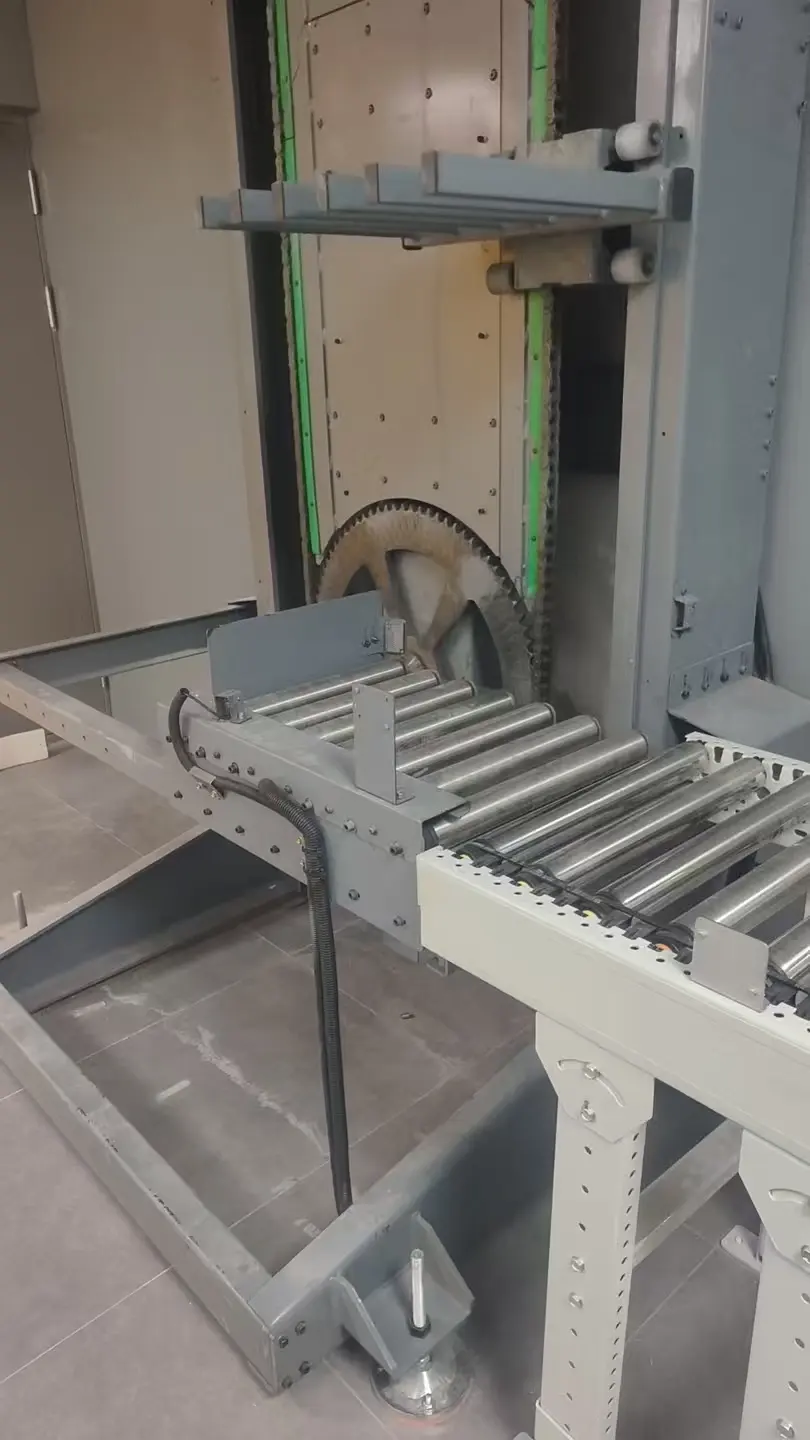
The system utilizes a continuous fork-arm elevator mechanism. The U-type forks (400mm x 500mm) are synchronized via a heavy-duty industrial chain drive. The forks are engineered to interleave with the 900mm-high input and output roller conveyors. This “comb-style” handover eliminates the need for pneumatic pushers, reducing the mechanical failure points and increasing the cycle rate.

3. Structural Reinforcement and Mounting
The guard plates are mounted using a 24-point fastening system (24-Φ16 holes) as per the CAD blueprints. This high-density fastening prevents the 0.5mm steel from resonating at high operating frequencies. The plates serve a dual purpose: they act as a safety barrier and as a structural “skin” that increases the torsional rigidity of the 5200mm vertical mast.

4. Electrical and Control Integration
The control system utilizes a variable frequency drive (VFD) to manage the ramp-up and ramp-down speeds of the fork arms. This ensures that the 20kg payload remains centered on the forks during the transition from horizontal to vertical movement. The VFD is integrated into a centralized PLC cabinet, providing real-time diagnostic feedback and emergency stop functionality synchronized with the horizontal sorter line.

Technical Specifications

The following parameters define the operational envelope of the fork-arm vertical conveyor deployed in the Turin project. These specifications reflect the upgraded state with integrated guard plates.

Parameter Specification
Equipment Model CVC-20-IT-TURIN
Rated Payload 20 kg
Overall Dimensions (LxWxH) 1400 mm x 1100 mm x 5200 mm
Fork Dimensions (Standard U-Type) 400 mm x 500 mm
Max Parcel Dimensions < 400 mm x 500 mm
Input/Output Interface Height 900 mm (from floor level)
Main Mast Material Reinforced Structural Steel
Guard Plate Material 0.5mm Q235A Steel
Drive System Synchronized Heavy-Duty Industrial Chain
Control Architecture PLC with Integrated VFD
Safety Compliance CE Certified / EN ISO 12100

By implementing the custom front guard plates and the U-type fork architecture, the facility in Turin achieved a significant reduction in Parcel Cycle Time (PCT) while maintaining absolute compliance with European safety mandates. The enclosure design ensures that the high-speed vertical conveyor operates as a “set-and-forget” asset within the automated electronics fulfillment workflow. The use of precision CAD-driven plate manufacturing allowed for a 100% fit-rate during the field modification, eliminating on-site cutting or welding requirements. This project demonstrates the necessity of moving beyond “frame-only” logistics to provide a fully integrated, safe, and high-performance vertical lifting solution.

Project Gallery