Need a Technical Advice?

40-Ton Heavy-Duty Optical-Guided AGV for Industrial Component Logistics in Italy

Project Overview

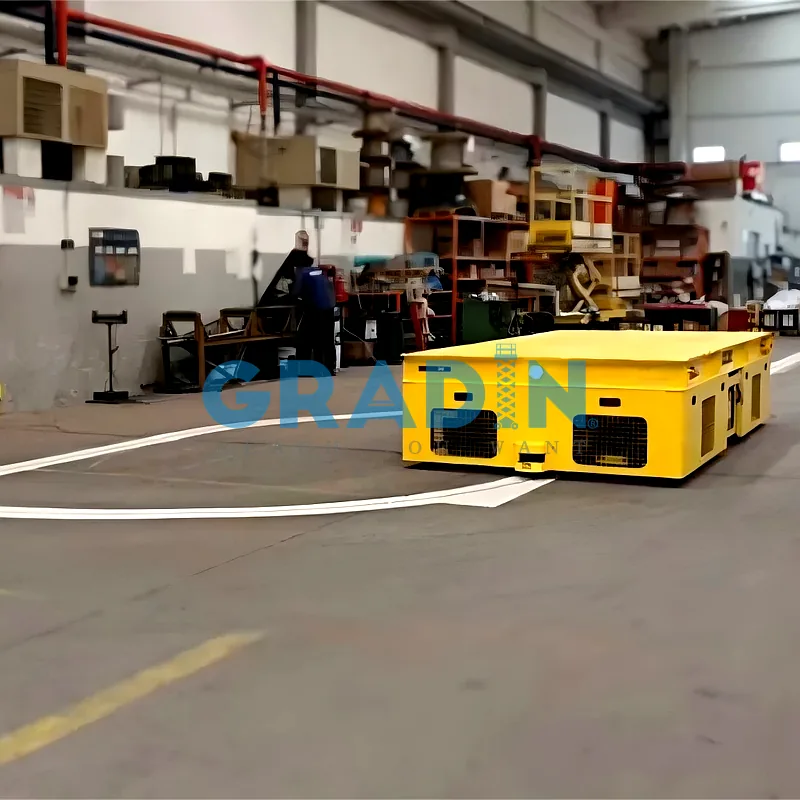
This project involved the deployment of a 40-ton heavy-duty Automated Guided Vehicle (AGV) at a specialized mechanical engineering facility in Turin, Italy. The facility, situated in a major European automotive and aerospace hub, required an autonomous solution for the cross-bay transport of oversized engine blocks and structural steel assemblies between the machining center and the final assembly line.

The primary technical objective was to transition from overhead crane-based logistics to a floor-based autonomous system to increase plant flexibility and reduce crane-wait times. This Internal Link: heavy-duty AGV transport vehicle utilized high-precision optical guidance technology to navigate a 120-meter transit path. The system was engineered to comply with the ISO 3691-4:2020 safety requirements for driverless industrial trucks and local Italian workplace safety mandates (CE certification), ensuring seamless integration into a high-traffic manufacturing environment.

Challenge & Solution

Challenge

The Turin facility presented a dense operational landscape where traditional magnetic tape or laser navigation faced significant environmental and logistical hurdles.

  • Dynamic Center of Gravity (CoG) for 40-Ton Loads: Transporting 40,000 kg structural components involves extreme inertial forces. Any sudden acceleration or deceleration in the  automated guided vehicle could lead to load shifting or floor damage.

  • Navigation Reliability in Metallic Environments: The facility’s high concentration of steel infrastructure and electromagnetic interference from heavy welding stations rendered standard magnetic and some early-stage wireless navigation systems unreliable.

  • Spatial and Turning Radius Constraints: The transit path included several 90-degree turns within narrow corridors. A 40-ton vehicle requires a sophisticated multi-wheel steering geometry to maintain a tight turning radius without scuffing the industrial floor coating.

  • Safety in Manned Work Zones: The AGV must operate in zones where human technicians and manual forklifts are present. The challenge was to ensure 360-degree obstacle detection that could distinguish between static infrastructure and dynamic human movement at high payloads.

  • Floor Loading and Surface Pressure: Distributing a 40-ton static load plus the vehicle’s self-weight (approx. 8 tons) required a specialized multi-axle wheel configuration to ensure the heavy-duty transporter did not exceed the local floor pressure limit of 10 N/mm².

Solution

To address the logistical requirements of the Turin plant, a customized AGV-40T-OPT-ITA was developed, focusing on optical path-following stability and high-capacity structural redundancy.

1. Optical Guidance and Path-Following Precision
The vehicle utilizes a high-resolution optical guidance sensor system that tracks a high-contrast white line applied to the floor. Unlike magnetic tape, this optical solution is immune to electromagnetic interference and offers a lower maintenance profile in heavy-metal environments. The onboard navigation controller executes real-time path correction with a tracking accuracy of ±10mm, ensuring the vehicle maintains its trajectory even under maximum 40-ton loading.

2. Multi-Axle Power-Steering and Load Distribution
The chassis is engineered with an 8-wheel configuration, utilizing high-density polyurethane vulcanized tires. Four of these wheels are independent drive-steer units, managed by a synchronized PLC-based motion control architecture. This allows the 40-ton AGV to execute “crab-steering” and “spin-turns,” significantly reducing the required operational footprint and distributing the load evenly to protect the facility floor.

3. Advanced Safety Scanning and Obstacle Avoidance
For human-machine collaboration safety, the vehicle is equipped with dual SICK microScan3 safety laser scanners mounted on diagonal corners. This provides a 360-degree safety field that is dynamically adjusted based on the vehicle’s speed and load weight. If an obstacle is detected within the “Warning Zone,” the AGV automatically modulates its speed; if the “Safety Zone” is breached, the Internal Link: heavy-duty AGV executes a controlled emergency stop within 150ms.

4. Energy Management and WMS Integration
The transporter is powered by a high-capacity Lithium Iron Phosphate (LiFePO4) battery array, optimized for 16 hours of continuous operation. The system integrates with the factory’s Warehouse Management System (WMS) via a secure Wi-Fi 6 gateway, allowing for automated dispatching, real-time status reporting, and predictive maintenance diagnostics.


Technical Specifications

Parameter Specification
Rated Load Capacity 40,000 kg (40 Metric Tons)
Guidance System High-Precision Optical (Line Following)
Navigation Accuracy ± 10 mm
Stop Accuracy ± 5 mm
Travel Speed (Full Load) 0.2 – 0.5 m/s (Adjustable)
Steering Type Multi-Axle Independent Steering
Dimensions (LxWxH) 5,200 mm x 2,800 mm x 850 mm
Safety Sensors 2x SICK microScan3 (360° Coverage)
Power Source LiFePO4 48V/400Ah Battery
Control Architecture PLC-based with Wi-Fi 6 WMS Interface
Min. Turning Radius 3,500 mm (Pivot Turn Capable)
Compliance CE / ISO 3691-4 / EN 1175

Project Gallery