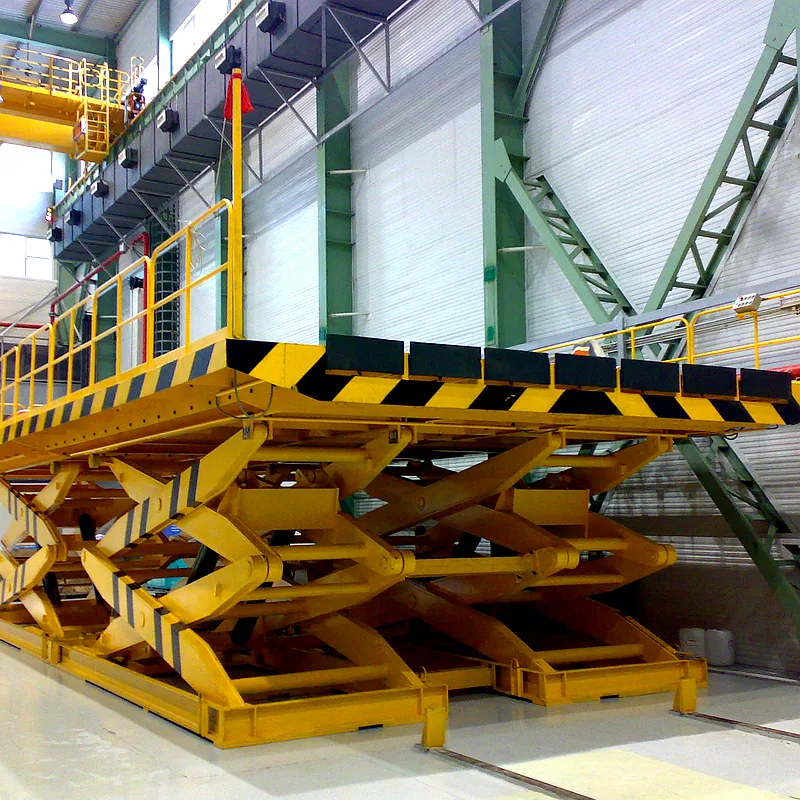
To address these technical requirements, a customized SL-20T-TDM (Tandem) scissor lift was engineered, prioritizing structural redundancy and advanced hydraulic synchronization.
1. Tandem Scissor Architecture and Structural Rigidity
The solution utilizes a tandem scissor mechanism, consisting of two synchronized sets of lifting linkages supporting a single 8000mm x 3000mm platform. This configuration is essential for distributing the 20,000 kg load across a wider base, effectively managing the asymmetric center of gravity of marine engines. The scissor arms were fabricated from high-tensile S355J2+N structural steel, with reinforced cross-members to minimize lateral deflection. This [Internal Link: tandem scissor lift] ensures that the platform remains stable even when the load is concentrated on one side during engine mounting.
2. PLC-Based Hydraulic Synchronization
Ensuring that both scissor sets rise and fall at the exact same rate was achieved through a closed-loop hydraulic synchronization system. Each scissor set is driven by dual high-pressure cylinders equipped with absolute linear encoders. A Siemens S7-1500 PLC monitors height data at 10ms intervals, adjusting proportional flow control valves in real-time to maintain a leveling accuracy of ±2mm. This eliminates the risk of platform tilting, which is critical for [External Link: marine engine assembly standards] where millimetric alignment is non-negotiable.
3. Manned Safety and Redundancy Systems
As the platform serves as an active workstation for technicians, safety features were engineered to exceed DIN EN 1570-1 requirements:
-
Aluminum Safety Trip Bars: Installed around the entire perimeter of the platform to immediately stop downward motion if an obstruction is detected.
-
Velocity-Sensing Burst Valves: Mounted directly to the cylinder ports to lock the platform in position if a hydraulic hose fails.
-
Mechanical Maintenance Locks: Integrated steel props that can support the full 20-ton load during scheduled maintenance intervals.
-
Slow-Start/Stop Inverter Control: Prevents the “hydraulic bounce” effect, providing a smooth transition during vertical adjustment to protect delicate engine components.
4. Marine-Grade Surface Protection
To combat the corrosive atmosphere of the Hamburg port zone, the entire structure underwent a three-stage coating process. After grit-blasting to SA 2.5 standards, a zinc-rich epoxy primer was applied, followed by a high-build micaceous iron oxide intermediate coat and a polyurethane topcoat (RAL 1003/Safety Yellow). All pivot pins were manufactured from stainless steel 17-4 PH to prevent seizing and ensure long-term maintenance-free operation.