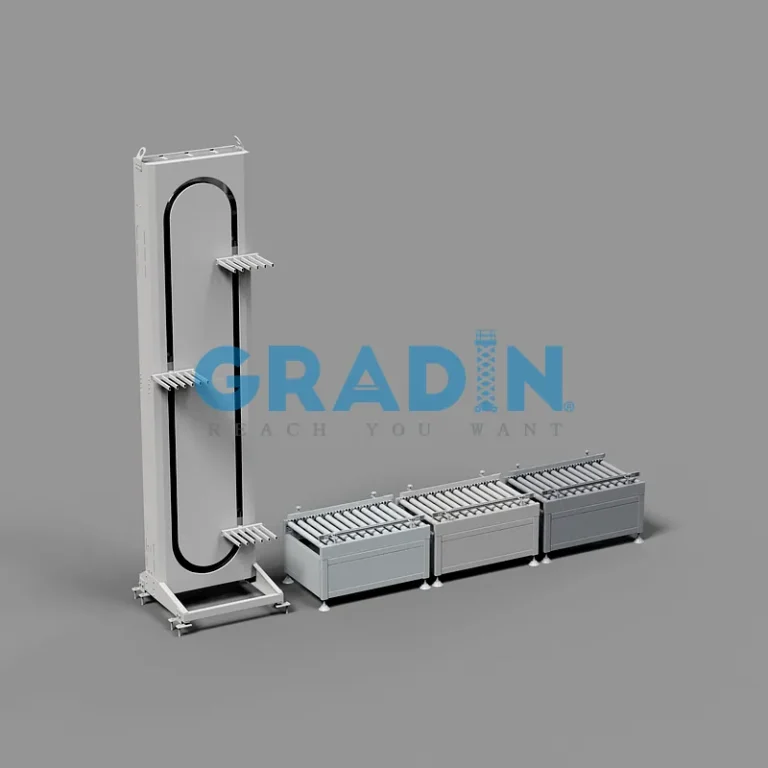
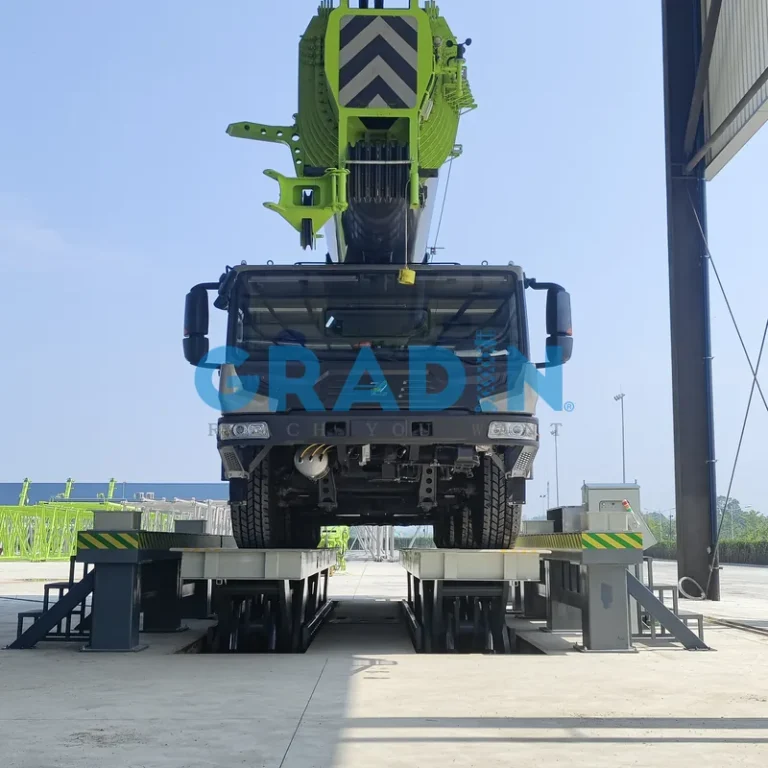
Supporting the continuous, unmanned vertical transfer of multi-ton industrial payloads demands a structural architecture that can withstand high-frequency dynamic loading. Gradin constructs these heavy-duty automated VRCs using wide-flange steel columns and redundant lifting media to ensure the carriage remains perfectly plumb under extreme weight distributions. The system utilizes onboard powered rollers or specialized chain transfer decks, relying on closed-loop PLC handshakes and photocell arrays to execute precise material indexing with adjacent horizontal conveyor lines. We engineer the drive motor torque, gearbox ratios, and structural tie-ins specifically to match the cycle rates and physical footprint of your facility’s high-volume production flow, eliminating the need for manual forklift intervention between elevations.
| Category | Dimension | Référence standard | Options sur mesure Gradin (ETO) |
| Core Performance | Payload & Stroke | Pre-set capacities (1T – 5T), Fixed strokes | Fully Bespoke: Scalable up to 150T+, millimeter-exact stroke, custom heavy-duty multi-belt arrays. |
| Structural & Material | Chassis Integrity | Standard rolled steel, basic welding | High-Yield Q355/Q460 Steel, FEA-validated mast and carriage, anti-deflection structural geometry. |
| Control & Intelligence | Drive & Automation | Relay logic, basic VFD, isolated operation | Siemens S7-1500 PLC, closed-loop servo synchronization, native Profinet/EtherCAT, AGV/WMS interface. |
| Environment & Safety | Operating Conditions | Ambient indoor, basic limit switches | ATEX Zone 1/2, C5-M Marine Grade, Cold Storage (-30°C), Redundant fail-safe mechanical braking. |
At Gradin, we do not assemble standard lifts; we design continuous vertical throughput nodes. Conventional chains and cables suffer from stretch, high maintenance requirements, and excessive particulate generation. Our 2-Stop Belt VRC System utilizes flat, steel-reinforced polyurethane belting, engineered for high-cycle, clean-running, and extreme-payload environments. Every mechanical constraint is modeled, simulated, and stress-tested before the first plate of steel is cut.
Steel-Reinforced Polyurethane Belt Dynamics
High-Tensile Load Distribution: Standard VRCs rely on localized chain stress. We engineer redundant, multi-belt arrays utilizing flat steel tension members encased in polyurethane. This distributes the kinetic load evenly across the drum, allowing us to engineer systems capable of handling 150T+ dynamic payloads without the maintenance burden of lubrication-dependent chains.
Particulate-Free Actuation: Because the belt structure requires zero external lubrication, the system operates without dispersing oil or metallic dust. This makes the architecture natively suitable for ISO Class 5 Cleanrooms, pharmaceutical intralogistics, and food-grade operations where contamination equals critical failure.
Acoustic & Resonance Control: Metal-on-metal drive systems generate harmonic resonance and factory noise. Our engineered belt drive absorbs mechanical vibration, delivering high-speed vertical indexing with minimal acoustic output, protecting operator environments and structural integrity over millions of cycles.
Closed-Loop Synchronous Drive Engineering
Absolute Encoder Positioning: Leveling accuracy dictates automated infeed efficiency. We deploy high-resolution absolute encoders directly wired into the Siemens S7-1500 PLC. This guarantees sub-millimeter carriage alignment at both stops, immune to power-loss position resetting.
Multi-Axis Drive Synchronization: For oversized or high-tonnage carriages, single-point lifting introduces lateral stress. We configure distributed SEW Eurodrive servo motors, electronically synchronized via real-time Industry 4.0 protocols to ensure the platform remains perfectly horizontal during maximum velocity transit, even when the payload is severely off-center.
Dynamic Torque Vectoring: The control architecture actively monitors motor draw during acceleration and deceleration phases. By utilizing precise VFD vector control, the system mitigates mechanical shock loads, resulting in zero payload shifting during vertical transfer.
Bespoke Carriage & Automation Interface
FEA-Validated Structural Decks: We do not use standard platform sizes. Your payload defines the geometry. The carriage framework undergoes rigorous Finite Element Analysis (FEA) to eliminate structural deflection. Whether the deck requires a 6-meter span for automotive chassis or specialized geometry for aerospace components, the structural stiffness remains absolute.
Native WMS/MES Handshake: The VRC functions as an intelligent data node. We program direct PLC logic to interface with your existing warehouse execution systems. The lift anticipates incoming payloads, pre-positions itself, and triggers infeed/outfeed commands to automated conveyors or AGV fleets with zero latency.
Active Top-Tooling: The carriage deck is fully configurable. We integrate bespoke motorized roller beds, continuous chain conveyors, or specialized pneumatic clamping jigs designed to secure your specific payload dimension the moment it transfers onto the system.
High-Throughput Automotive Stamping Facilities
Le défi : Transferring heavy steel blanks and finished body panels between ground-level stamping presses and secondary-level automated welding cells. The process demands zero contamination (no chain oil), high cycle rates, and exact alignment for robotic unloading.
The Gradin Solution: We deploy a high-capacity 2-Stop Belt VRC System equipped with custom V-groove docking jigs on the carriage. The particulate-free belt mechanism eliminates oil drop risks. Synchronized servo motors deliver high-speed indexing, reducing floor-to-floor cycle times, while the Siemens control architecture hands over the load directly to the robotic cell with absolute positional accuracy.
Automated Deep-Freeze Intralogistics (-30°C)
Le défi : Vertical transfer of palletized frozen goods between staging and storage levels. Standard hydraulic fluids thicken, and metal chains become brittle and fail under continuous thermal shock and ice buildup.
The Gradin Solution: A bespoke vertical lift engineered with thermal-rated polyurethane belting that maintains flexibility at extreme negative temperatures. The drive system utilizes specialized low-temperature lubricants, and the IP65-rated control panels are climate-controlled. The system integrates directly with automated cold-storage retrieval machines (AS/RS), operating 24/7 without the maintenance downtime inherent to chain-driven lifts in freezing environments.
Lithium-Ion Battery Manufacturing
Le défi : Moving high-density battery material totes between coating and calendering floors. The environment requires extreme cleanroom standards, strict fire-safety compliance, and heavy load capacities due to the density of raw materials.
The Gradin Solution: A fully enclosed, cleanroom-certified 2-Stop Belt VRC System. The mechanical design eliminates all metal-to-metal drive friction, meeting strict ISO particulate limits. The chassis is FEA-validated to handle the concentrated point loads of dense material totes, and the entire system is wired for ATEX compliance, ensuring intrinsically safe operation in environments with volatile solvent fumes.
Vertical material handling at industrial scales requires an uncompromising approach to risk mitigation. Standard compliance is merely the baseline; Gradin engineers safety architecture as a continuous, redundant loop.
Slack-Belt & Tension Monitoring: The system actively measures tension across the entire belt array. If dynamic load shifting causes unequal tension or slack is detected, the SICK safety sensors instantly trigger the braking system, halting the drive before a fault can propagate.
Fail-Safe Mechanical Arrestors: In the absolute worst-case scenario of complete drive failure, mechanically actuated overspeed cams immediately engage the vertical guide rails. This kinetic locking mechanism secures the carriage in place independent of the electrical system, preventing free-fall.
Perimeter Safety Interlocks: We design fully integrated shaft enclosures with electro-mechanical door interlocks. The PLC logic strictly prevents the carriage from indexing if a shaft gate is compromised, and prevents gates from opening unless the carriage is perfectly leveled and mechanically locked at the respective floor.
Pour cette série de produits à usage intensif, nous pouvons concevoir des capacités de charge allant jusqu'à [300] tonnes, Le système de levage est conçu pour répondre à des besoins spécifiques, avec des dimensions de plate-forme et des hauteurs de levage adaptées à votre domaine d'activité. Les exigences dépassant notre matrice d'ingénierie standard seront soumises à une analyse par éléments finis (FEA) par notre équipe d'ingénieurs afin de garantir la viabilité structurelle avant de proposer une solution.
Pour lancer la proposition d'ingénierie, veuillez fournir les données de base suivantes :
Capacité de charge nominale
Hauteur de levage maximale et hauteur fermée
Dimensions de la plate-forme (L x L)
Cycle de fonctionnement (par exemple, cycles opérationnels par heure/jour)
Conditions environnementales (par exemple, intérieur/extérieur, lavage, antidéflagrant)
Contraintes liées à la profondeur de la fosse ou à l'espace libre au-dessus de la tête
Oui, les systèmes de contrôle peuvent être équipés de protocoles de communication standard (par exemple, Profinet, Modbus, Ethernet/IP) qui utilisent des systèmes de communication standard. [Siemens / Allen-Bradley / Omron] PLC. Cela garantit une synchronisation transparente des signaux d'E/S avec les convoyeurs en amont et en aval, les unités AGV/AMR et votre salle de contrôle centrale.
Chaque unité personnalisée fait l'objet d'un test d'acceptation en usine (FAT) obligatoire avant d'être expédiée. Ce test comprend des essais opérationnels continus à une charge nominale de 100%, des essais de surcharge statique à [120% / 125%] et le déclenchement physique de tous les verrouillages de sécurité mécaniques anti-chute et hydrauliques. La documentation FAT et la preuve vidéo sont incluses dans votre dossier d'ingénierie.
Après l'approbation finale des plans d'ensemble (GA), le délai de fabrication est généralement de 4 à 8 semaines. Les composants structurels surdimensionnés sont conçus de manière modulaire pour s'adapter aux conteneurs d'expédition standard (20FT/40HQ). L'assemblage sur site utilise des raccords de bride boulonnés et des bouchons d'aviation robustes, ce qui élimine totalement le besoin de soudure sur site.
Nous fournissons un standard [12/24]-La garantie couvre le cadre structurel et les principaux composants hydrauliques/électriques. Pour minimiser les temps d'arrêt, un ensemble complet de consommables standard (par exemple, kits de joints de vérins, interrupteurs de déplacement, relais) est expédié avec votre équipement. Pendant la période de garantie, les pièces de rechange en cas de défaillance non provoquée par l'homme sont expédiées par fret aérien prioritaire (DHL/FedEx) dans les 48 heures.
Au-delà de la garantie, nous garantissons soutien technique à vie. Les dessins CAO, les schémas électriques et la nomenclature de votre équipement personnalisé sont archivés en permanence dans notre système. Vous êtes ainsi assuré de bénéficier d'un dépannage à distance ininterrompu, de conseils de maintenance et d'une correspondance exacte des pièces de rechange pendant tout le cycle de vie de l'équipement.
🔒 Sécurisé et confidentiel : Votre proposition technique et votre conception 3D seront prêtes en 2 heures.
Gradin Machinery est un fabricant de premier plan spécialisé dans les plates-formes élévatrices et les solutions de levage hydraulique. Certifiés ISO et CE, nous fournissons des équipements sûrs, fiables et personnalisés pour répondre aux besoins de l'industrie mondiale.
Copyright ©2026 GRADIN Machines. Tous droits réservés