Besoin d'un avis technique ?

Système de levage hydraulique synchronisé en L de 5 tonnes pour des poutres en acier de 35 mètres à Newcastle, Australie

Présentation du client

This engineering project involved the design, structural analysis, and implementation of a synchronized hydraulic upending system for a Tier-1 infrastructure fabrication facility in Newcastle, New South Wales, Australia. The facility specializes in the production of massive 35-meter structural steel spans and bridge girders for Australia’s expanding rail and road networks.

The primary technical objective was to provide a high-stability, 90-degree tilting solution for 35-meter long steel beams, which previously required high-risk, multi-crane tandem flips. The solution utilized a coordinated array of three 5,000 kg (5-ton) L-type hydraulic upender machines, all managed by a centralized control architecture to ensure simultaneous rotation without inducing torsional stress on the elongated workpieces. The system was engineered to meet the rigorous AS/NZS 3000 electrical standards and AS 1418.1 for cranes and hoists, ensuring full compliance with Australian Work Health and Safety (WHS) regulations.

Défi et solution

Défis pour les clients

The manipulation of 35-meter structural members presents extreme mechanical risks, primarily regarding the shift in the center of gravity (CoG) and the potential for structural deformation during the 90-degree rotation. The engineering team identified several critical bottlenecks:

  • Long-Span Torsional Deflection: Rotating a 35-meter beam using localized contact points creates a massive risk of “corkscrewing” if the lifting points do not move in perfect synchronization. Any millimetric lag between the tilting units could lead to permanent structural fatigue or buckling of the beam.

  • Massive Center of Gravity (CoG) Shift: As the beam transitions from a horizontal to a vertical orientation, the CoG moves through a high-torque arc. Standard tilters lack the structural mass and hydraulic dampening to manage this transition safely for a 5,000 kg per unit payload.

  • Site-Specific Electrical Requirements: The Newcastle facility operates on a 415V, 50Hz, 3-Phase grid. The hydraulic power units required high-efficiency motors to maintain constant pressure across a 14-meter cabling run, necessitating the use of specialized Schneider Electric industrial motor protection to prevent phase loss.

  • Spatial Constraints and Low-Profile Requirements: The facility required a “pit-less” installation where the platform height in the stowed position was no more than 500 mm. This necessitated a compact, high-force scissor-pivot design for the 90-degree tilting platform .

  • Synchronized Control Over 14 Meters: Managing three independent tilters from a single station required a robust electrical logic that could compensate for the hydraulic resistance inherent in 14-meter pipe runs, ensuring that each unit reached its 90-degree target simultaneously.

Solution personnalisée GRADIN

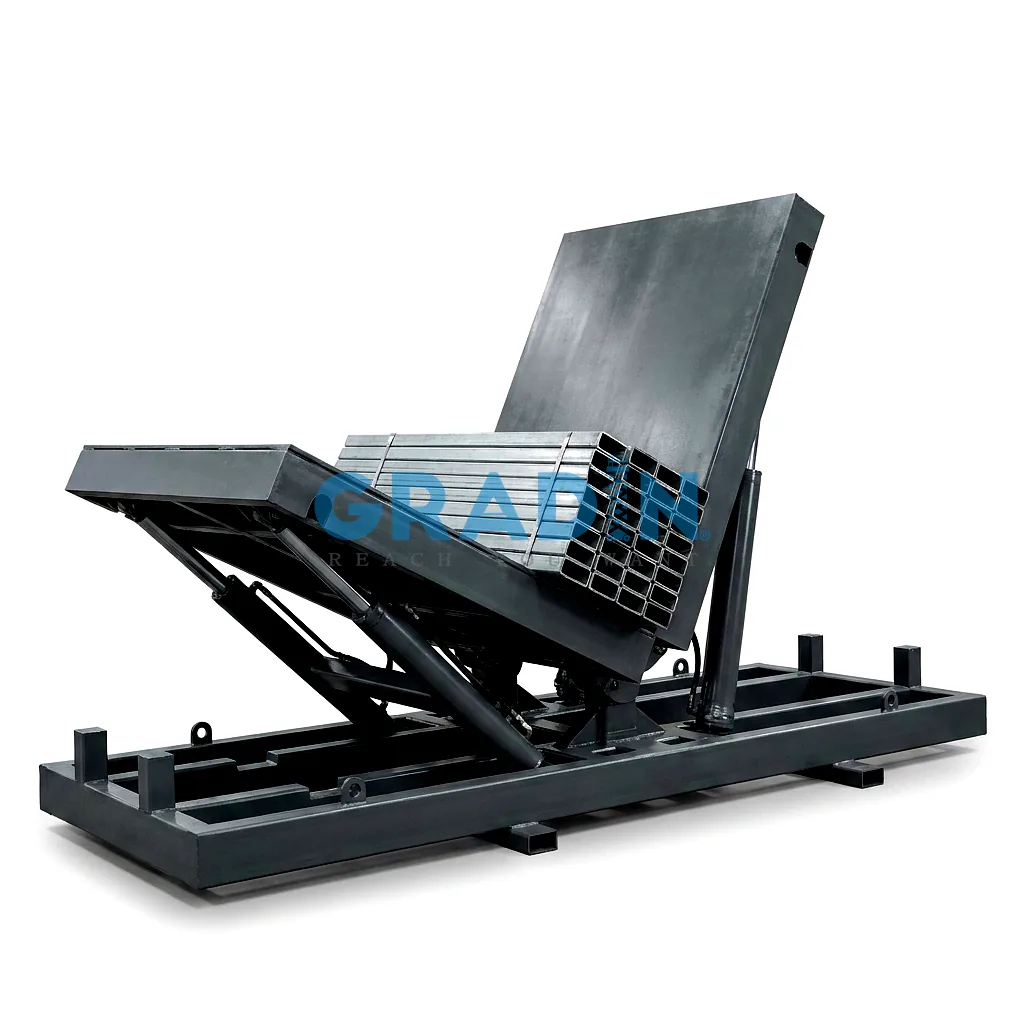
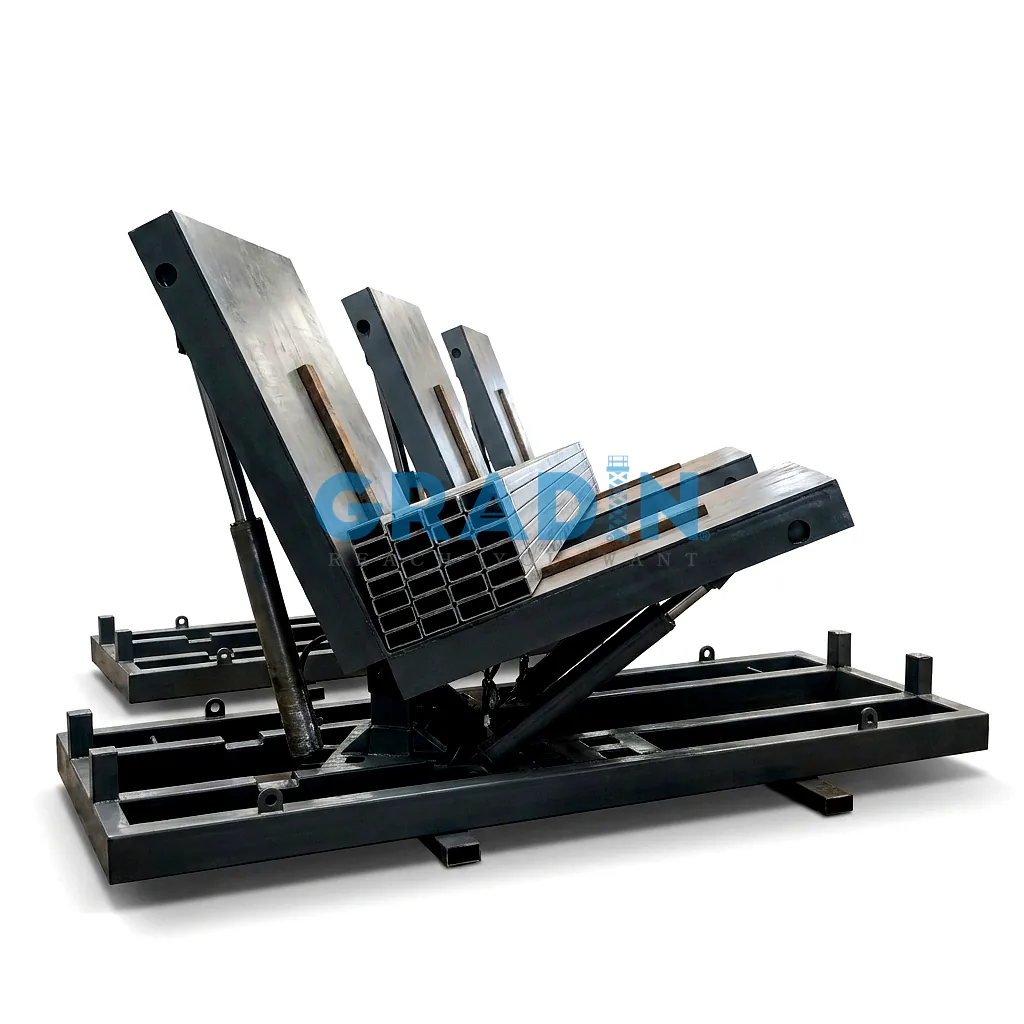
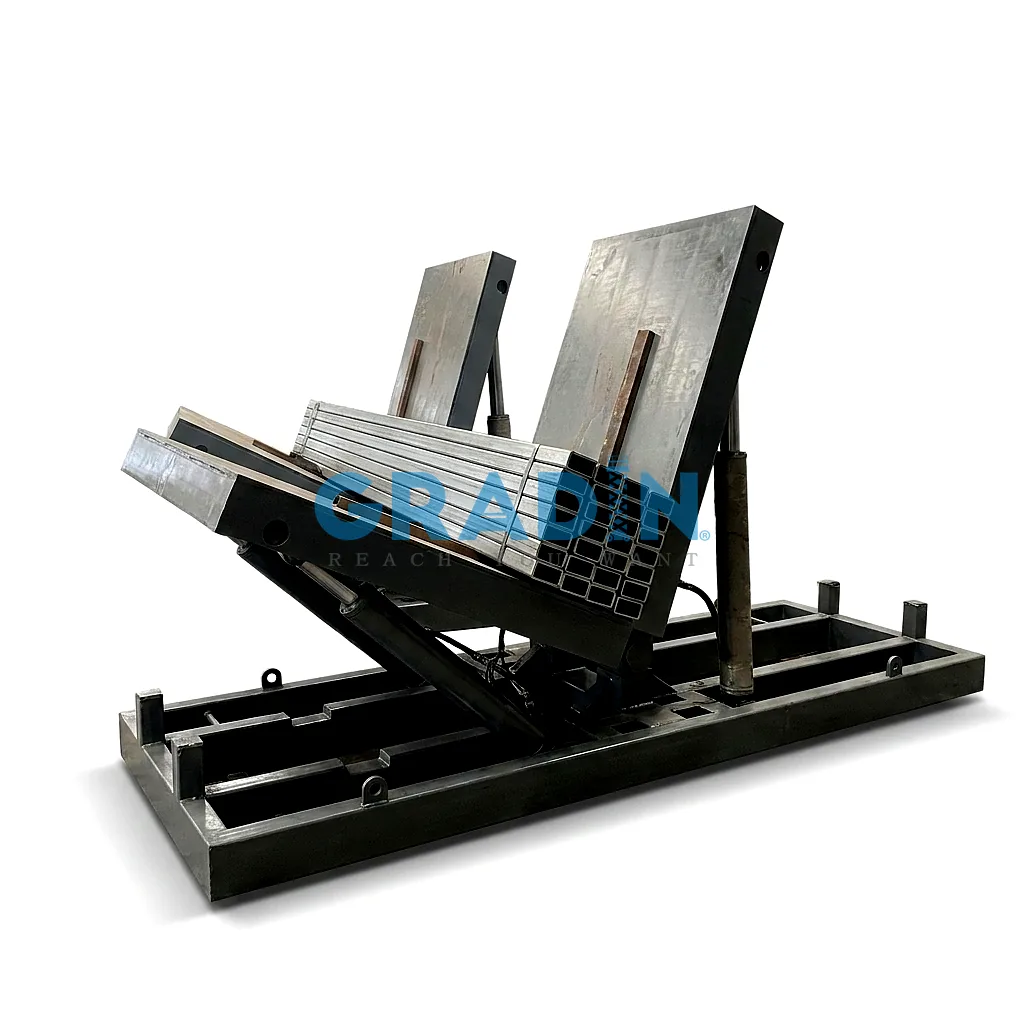
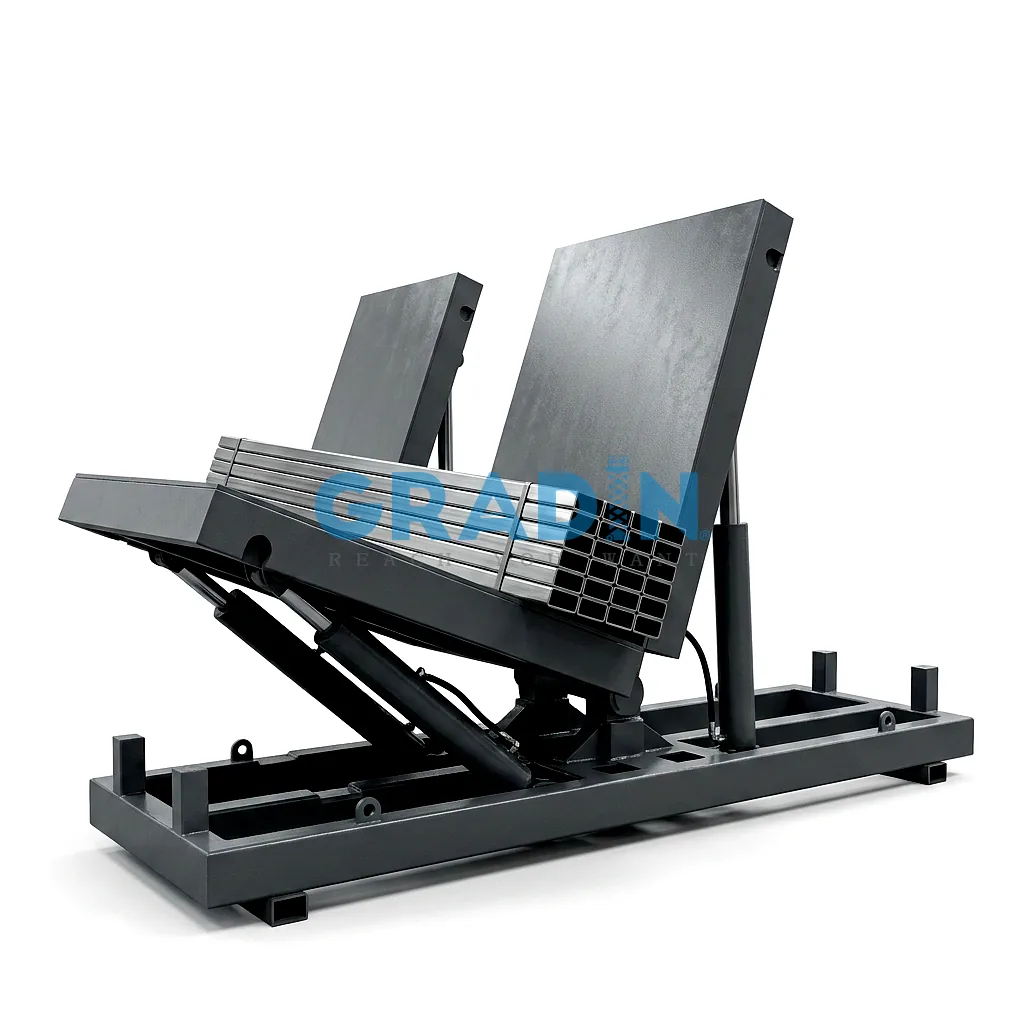
To address these technical requirements, a synchronized system of three L-Series Heavy-Duty Tilters was deployed, prioritizing structural rigidity and centralized hydraulic logic.

1. Synchronized Triple-Unit Control Architecture
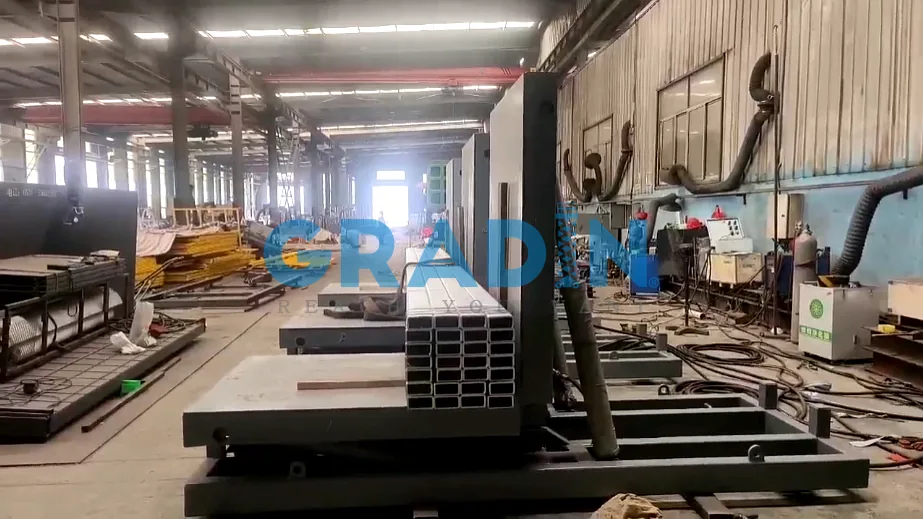
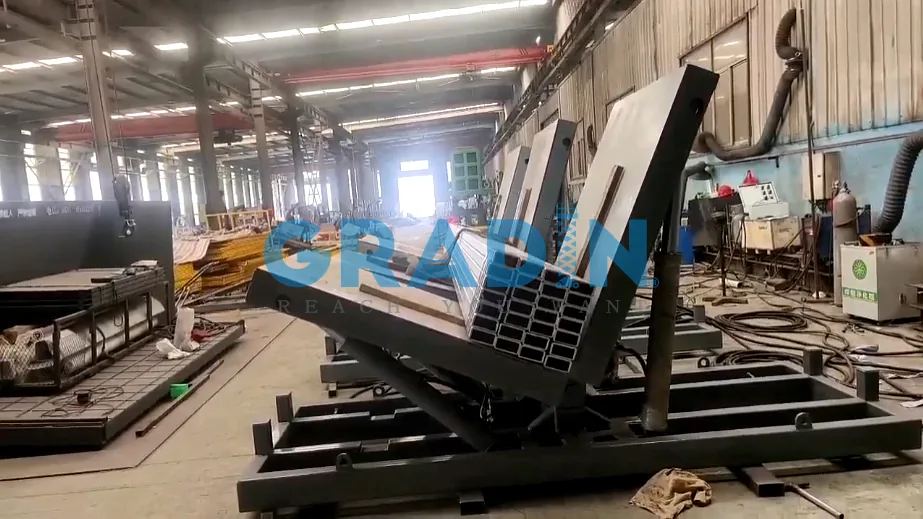
The system features a centralized control cabinet that manages three independent 5-ton tilters. This architecture uses a master-slave PLC logic to ensure that hydraulic flow to all twelve cylinders (four per unit) is balanced. The synchronized hydraulic upender utilizes a single 7.5kW power unit to drive the synchronized flip, ensuring that the 35-meter beam is supported evenly across its entire length, eliminating the risk of torsional deflection.

2. High-Force Quad-Cylinder Actuation
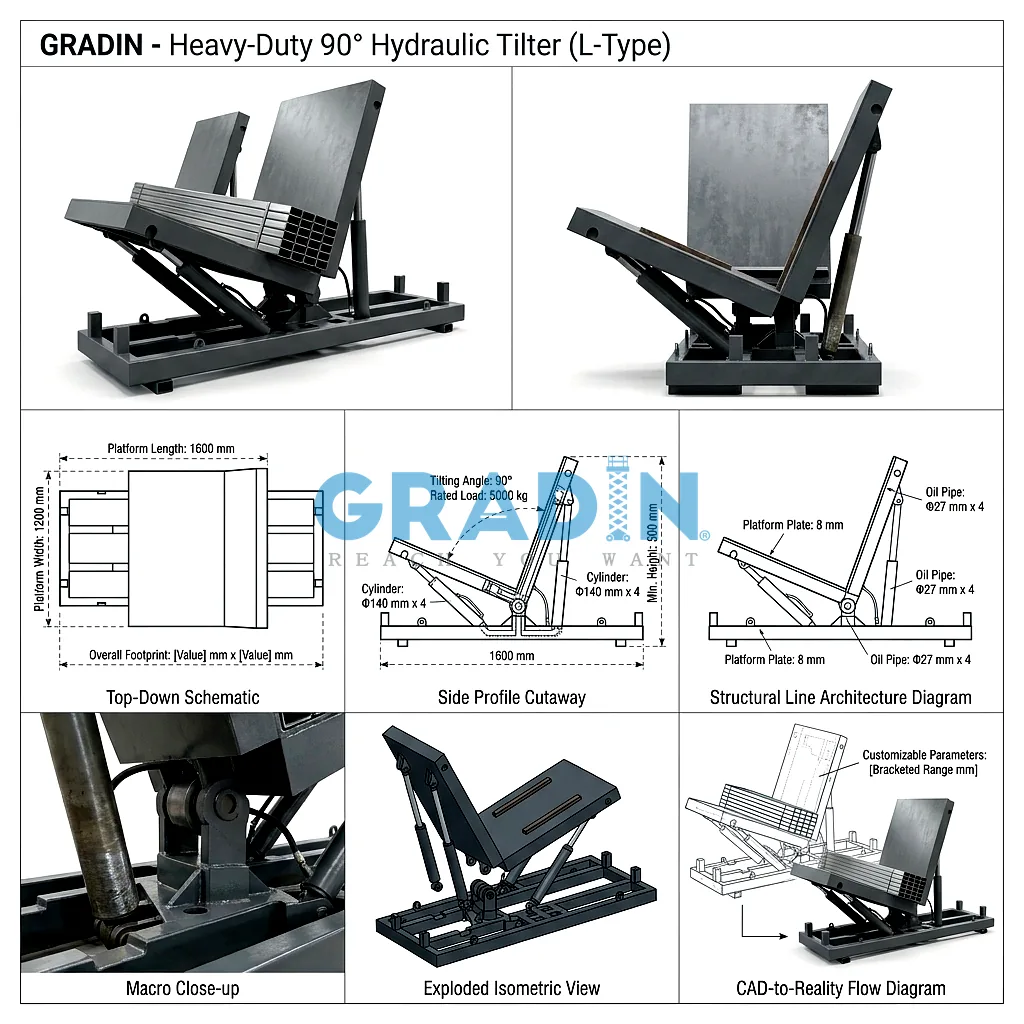
Each 1600mm x 1200mm L-platform is driven by four Φ140mm heavy-duty hydraulic cylinders. This quad-cylinder configuration provides a broad distribution of force, allowing each unit to handle its 5,000 kg rated load with a 2.5:1 safety factor. The use of high-precision   induction-hardened chrome piston rods ensures that the cylinders can withstand the grit and atmospheric salinity typical of the Newcastle coastal industrial zone.

3. Low-Profile Structural Frame (500mm Stowed Height)
To meet the client’s requirement for easy forklift loading without a pit, the base frame was engineered using reinforced 16# channel steel and 8mm chequered plate. This achieved a stowed height of 500mm while maintaining the structural mass necessary to prevent the tilter from “walking” during high-torque rotations. The L-shaped platform geometry ensures that the 35-meter beam is cradled on two axes during the entire 90-degree flip.

4. Advanced Electrical and Safety Systems
The electrical system was built using Delixi industrial components, featuring a 14-meter shielded cable run to allow for the vast spacing required for 35-meter beams. Safety logic includes:

  • Emergency Stop Redundancy: Integrated into the handheld remote and the main panel.

  • Pressure-Compensated Flow Control: Prevents the “over-center” effect where gravity accelerates the beam’s rotation.

  • Integrated Limit Switches: Ensure the system halts precisely at 0 and 90 degrees to protect the from pressure spikes.

Paramètres techniques et marques de soutien

Paramètres techniques

The following table outlines the engineering parameters for the triple-unit synchronized system deployed in Australia.

Paramètres Technical Specification (Per Unit)
Capacité de charge nominale 5,000 kg (5.0 Metric Tons)
Synchronized Configuration 3 Units Managed by 1 Control Box
Platform Dimensions (L-Type) 1,600 mm x 1,200 mm
Flipping Angle 0 – 90 Degrees
Hydraulic Cylinders Φ140 mm * 4 Units per Tilter
Power Unit 7.5 kW / 415V / 50Hz / 3P
Stowed Height (Low Profile) 500 mm
Platform Surface 8 mm Anti-Slip Chequered Plate
Control Logic Delixi Industrial Electricals / PLC Sync
Cable Length 14,000 mm (14 Meters)
Cycle Time 90 – 120 Seconds (Adjustable)

By implementing this synchronized hydraulic upender system, the Newcastle facility successfully eliminated tandem crane flips, reducing the rotation cycle time for 35-meter beams by 70%. The structural rigidity provided by the L-frame and the millimetric precision of the quad-cylinder drive ensures that high-value bridge girders are manipulated without surface damage or structural fatigue. The entire project followed ISO 9001:2015 quality management protocols, ensuring that this critical infrastructure investment provides a safe, reliable service life for the Australian steel fabrication industry.


Soutien aux marques

Nos machines basculantes adoptent des composants de première qualité, importés et de marque nationale, pour la commande électrique, les pièces pneumatiques, hydrauliques et mécaniques.
1. Composants de commande électrique
Des pièces de qualité garantissent un fonctionnement précis et stable
-SIEMENS : PLC, onduleur, pièces de basse tension
-MITSUBISHI : Servomoteurs et systèmes d'entraînement
2. Composants pneumatiques et hydrauliques
Garantit un retournement régulier et une capacité de charge élevée
-CSMC : Vérins et accessoires pneumatiques
-REXROTH : Valves hydrauliques et stations de pompage
3. Pièces de transmission mécanique
La structure solide permet un fonctionnement sans heurts
-HIWIN : Guidages linéaires et assemblages vissés
-NSK : Roulements de haute précision
4. Pièces de distribution basse tension
-CHINT/DELIXI : Disjoncteurs et interrupteurs
-EATON : Composants de sécurité et de distribution

Exécution du projet et réalisations

Détails de la mise en œuvre

Exécution et réalisations

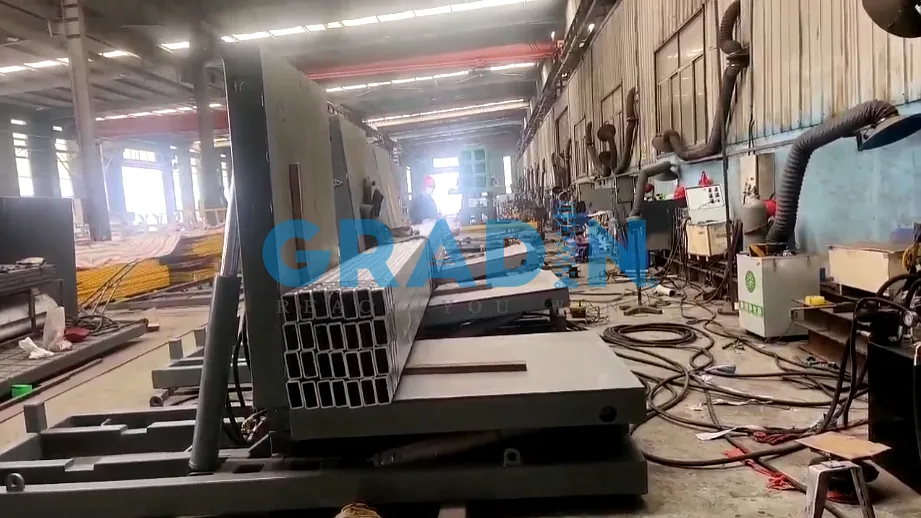
For an Australian Newcastle-based steel structure manufacturer, we delivered a custom 5-ton L-type synchronous hydraulic upender system, specially optimized for handling 35-meter ultra-long steel beams. The tailored solution fully replaces risky, inefficient crane-assisted manual flipping, delivering significant improvements in productivity, cost savings, operational safety and product quality.
1. Dramatic Production Efficiency Improvement
Traditional flipping for 35m long steel beams required 20–30 minutes per unit with unstable workflow due to multi-worker coordination and repeated crane calibration. Our synchronized hydraulic upender completes precise 180° flipping and accurate positioning in just 2–3 minutes per cycle. Single-beam processing efficiency increased by over 85%, effectively eliminating production bottlenecks and boosting overall line throughput.
2. Great Labor Cost Reduction
The original operation relied on 3–4 skilled workers for rigging, crane control and safety monitoring. The automated upender supports single-person operation, cutting labor staffing from 4 to 1 worker. It eliminates efficiency fluctuations caused by human factors and greatly reduces long-term labor costs while maintaining stable output.
3. Zero Damage & Zero Rework Quality Upgrade
Manual flipping easily causes beam offset, collision, stress imbalance, surface scratches and structural deformation, resulting in frequent rework. The customized L-type bearing structure perfectly fits ultra-long steel beam stress characteristics. The synchronous hydraulic balancing system ensures stable, shake-free flipping, achievingzero deformation, zero scratches and zero rework, lowering material waste and improving finished product qualification rate.
4. Safer & More Continuous Production
Conventional crane flipping involves major safety hazards including load imbalance and workpiece swinging. Equipped with overload protection, emergency stop and hydraulic self-locking devices, this customized upender complies with Australian industrial safety standards, eliminates high-risk manual hoisting, and supports 24-hour continuous cyclic operation for maximum equipment utilization.
5. Site-Tailored Custom Solution
Optimized for the oversized 35m beam specifications and limited workshop space, the compact L-type synchronous structure solves the poor synchronization and low positioning accuracy of standard upenders on ultra-long workpieces. It provides a highly adaptable automated flipping solution for large steel structure fabrication projects.
Avantages globaux du projet
After equipment deployment, the client achieved 80%+ higher overall production efficiency, 75% less labor investment and zero rework rate. The production line realized standardized, automated and continuous operation, bringing stable long-term cost-saving and efficiency-enhancing benefits for local project delivery.
Équipement recommandé

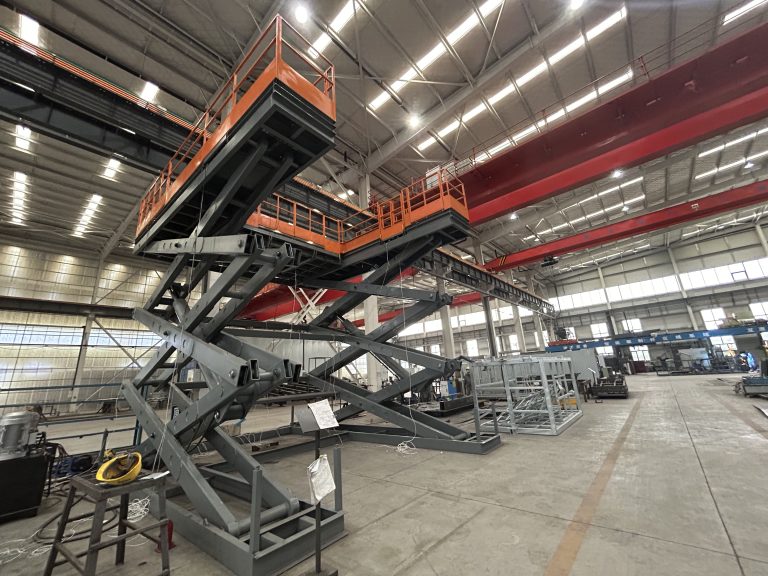
Plate-forme élévatrice pour poste d'assemblage vertical sur mesure - Plate-forme modulaire à hauteur réglable

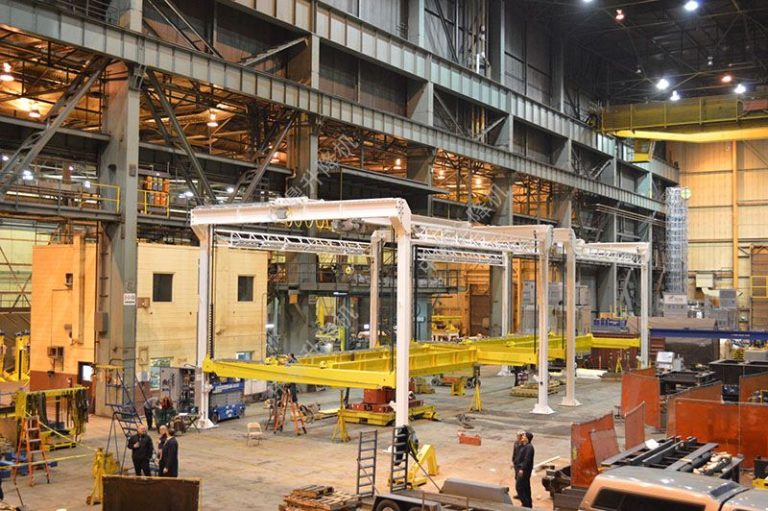
Plate-forme élévatrice de personnel pour l'assemblage des moteurs de locomotives - Plate-forme d'entretien des moteurs de chemin de fer

Plate-forme de levage pour l'assemblage d'équipements aéronautiques à grande échelle - Plate-forme de levage aérospatiale de haute précision

Pont élévateur à quatre colonnes avec moteur à vis - Plate-forme élévatrice mécanique synchrone à quatre colonnes