Product Name:Composite Pipe RGV
Product Model: Gradin CPR-RGV Series
Capacité de charge: 5000 – 50000kg (Customization Available)
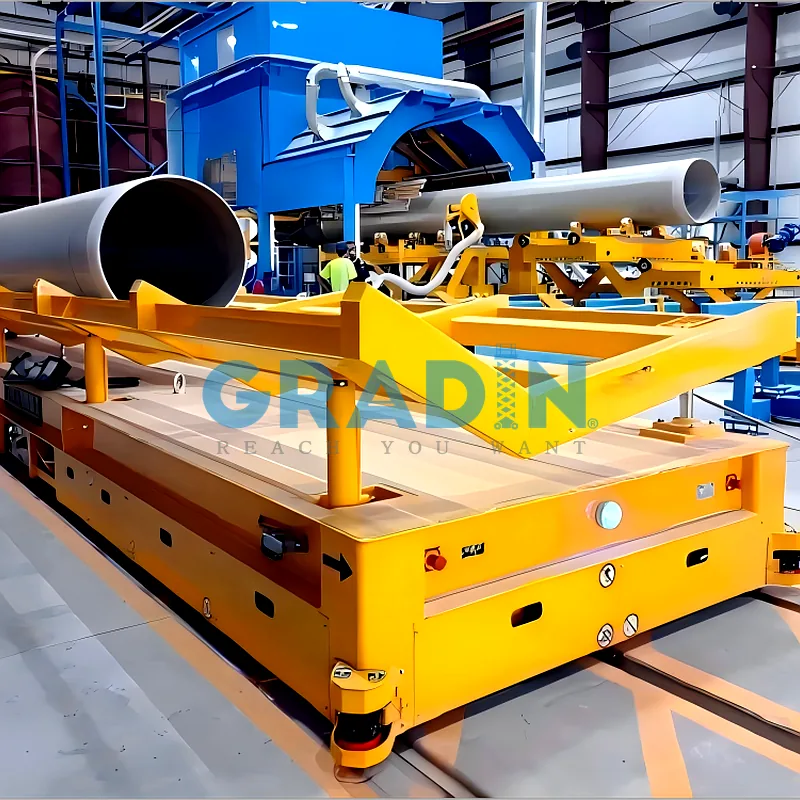
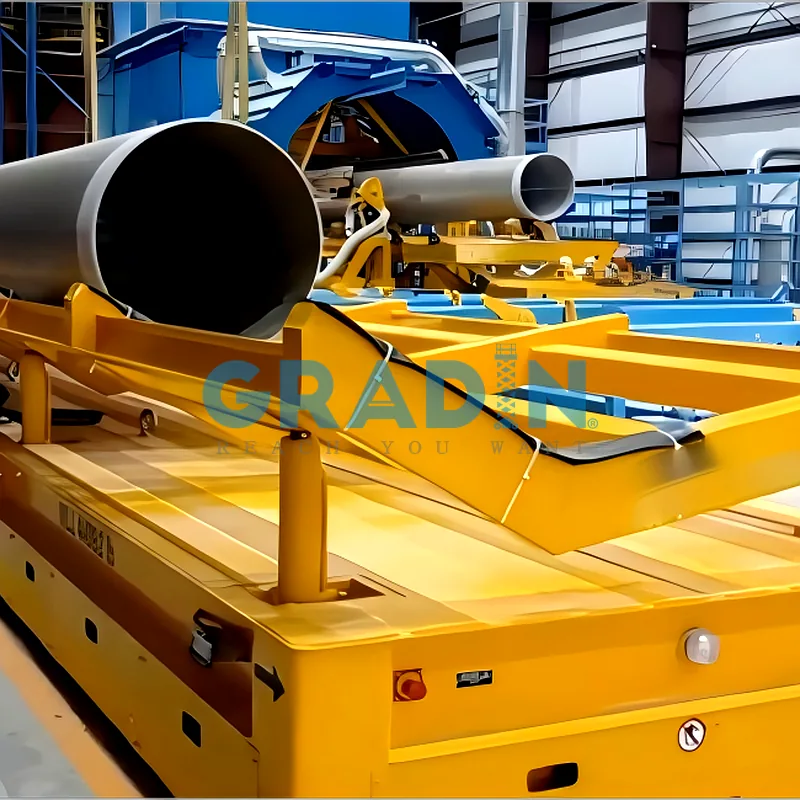
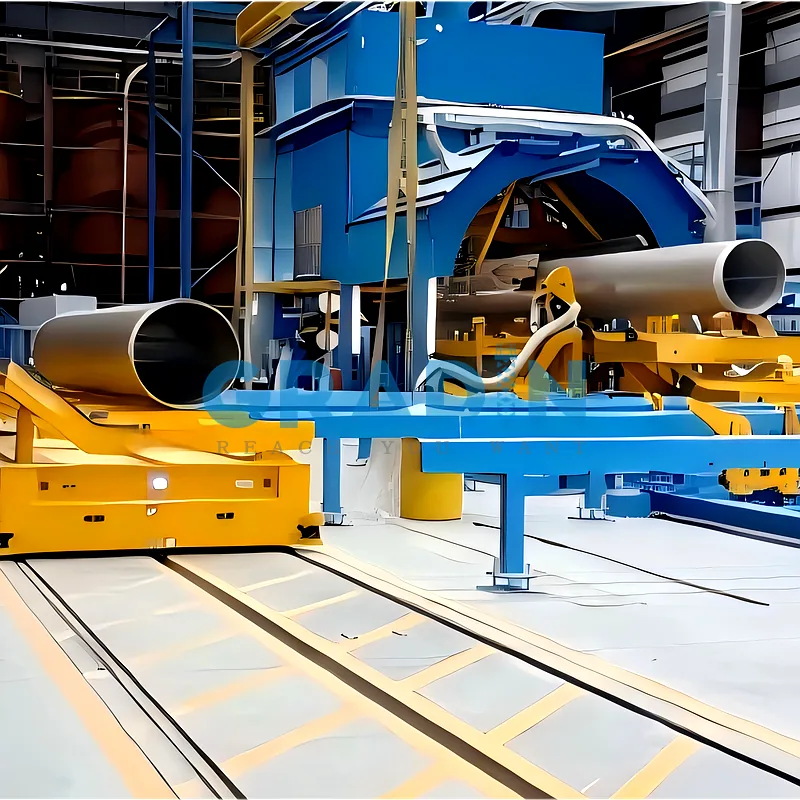
This Composite Pipe RGV acts as a precision rail-guided transit system for the specialized movement of composite piping and other sensitive long-load materials. Built by Gradin as a custom engineered-to-order (ETO) solution, the vehicle is integrated with non-marring contact surfaces and specialized cradles to protect the structural integrity of high-value composite components. Designed for seamless integration into fixed rail infrastructures, this Composite Pipe RGV ensures stable, vibration-free transport and absolute positioning accuracy, providing a superior alternative to traditional manual handling in advanced manufacturing environments.
| Paramètres d'ingénierie | Référence standard | Gradin Bespoke Capabilities |
| Capacité de charge nominale | 10 000 kg (10 tonnes) | Scalable from 2,000kg to 30,000kg (30T) |
| Navigation Mode | Rail-Guided (RGV) | Encoder + Laser Station Positioning |
| Travel Speed | 30 m/min (Reference) | High-Speed Configurations up to 80 m/min |
| Précision du positionnement | ± 5 mm | Millimeter-Level Calibration (± 2 mm) |
| Cradle Protection | Basic Steel V-Saddle | Bespoke Nylon/UHMWPE/Rubber Cladding |
| Control Logic | Handheld Remote | Gradin PLC-Integrated / MES / WMS Connectivity |
Gradin Composite Pipe RGV Structural Integrity and Deflection Control
Composite pipes, particularly those used in offshore or chemical industries, are susceptible to structural damage if subjected to excessive bending during transit. Every Gradin Composite Pipe RGV is engineered using Finite Element Analysis (FEA) to simulate the specific support points required for your pipe lengths. Our bespoke chassis engineering ensures that the vehicle maintains a perfectly rigid platform, providing multi-point support that prevents material deflection. This engineering-first approach preserves the structural integrity of the composite layers, especially during high-acceleration rail transitions, ensuring that your high-value cargo arrives at the next production stage in pristine condition.
Gradin Composite Pipe RGV Surface-Safe Cradle and Clamping Technology
Unlike standard steel-on-steel handling, the Gradin Composite Pipe RGV features an application-specific cradle design tailored to protect delicate external coatings and resin layers. We utilize non-marking, soft-touch materials such as high-density polyurethane or UHMWPE for all contact surfaces. Our bespoke clamping systems are engineered with pressure-sensing technology to secure the pipes during high-speed travel without exceeding the material’s crush-resistance limits. This precision load security is essential for maintaining the safety of the cargo during rapid start-stop cycles in automated factory environments.
Gradin Composite Pipe RGV High-Precision Docking and Automation
In automated composite winding or curing lines, the docking accuracy of the RGV is critical for process continuity. The Gradin Composite Pipe RGV utilizes high-resolution encoder feedback and laser distance sensors to achieve millimeter-perfect positioning (±2mm) at every workstation. Through an open-architecture PLC control system, the RGV communicates directly with your MES (Manufacturing Execution System) via industrial Wi-Fi or 5G. This allows for fully autonomous operational logic, where the RGV can automatically request mandrel transfers, coordinate with robotic arms, and manage cooling-zone dwell times without human intervention, creating a truly synchronized material flow.
Offshore Marine Pipe and Subsea Flowline Manufacturing
Le Gradin Composite Pipe RGV is the premier professional choice for manufacturing facilities producing heavy-duty subsea flowlines and flexible risers. By providing a synchronized rail-guided platform, we allow for the safe movement of exceptionally long pipe sections through the winding and testing phases. We customize the RGV with motorized rotation rollers bespoke to your inspection requirements, allowing the pipe to be rotated 360 degrees for NDT (Non-Destructive Testing) while remaining securely on the shuttle, significantly reducing the need for overhead crane lifts.
Chemical Processing and Corrosive Fluid Pipeline Logistics
In facilities producing glass-reinforced plastic (GRP) or specialized chemical pipes, maintaining a clean and controlled transport method is mandatory. We engineer the Gradin Composite Pipe RGV with corrosion-resistant coatings and sealed electronics, allowing it to operate reliably near chemical treatment baths or high-humidity curing rooms. The bespoke steering and docking logic ensuring that these sensitive components are delivered to the exact coordinates required for flange welding or secondary machining, turning a complex manual handling task into a safe, automated logistics operation.
Automated Curing, Winding, and Finishing Line Integration
For modern composite plants moving toward Industry 4.0, the Gradin Composite Pipe RGV acts as the high-speed link between disconnected production zones. We customize the power management system—offering either high-capacity Lithium-Ion battery modules or automated cable reels—to match your travel distances and cycle times. The RGV’s ability to communicate with Industry 4.0 WMS systems ensures that every pipe section is tracked in real-time, optimizing the flow between the winding station and the final curing oven, reducing logistical bottlenecks and improving overall production throughput.
Redundant Safety Architecture and Multi-Layered Protection
Transporting massive composite structures requires sophisticated safety protocols that go beyond basic regulations. Every Gradin Composite Pipe RGV is integrated with a redundant safety architecture, including industrial-grade laser scanners that create a programmable 360-degree “safety zone” around the vehicle. In the event of an unexpected obstruction or a deviation in rail stability, the intelligent control system executes a controlled deceleration to protect the personnel and the high-value cargo. Furthermore, we integrate emergency stop-pull cords and acoustic-optic warning signals, ensuring that your automated rail system operates with the highest safety rating in the industry (ISO 3691-4/CE).
Pour cette série de produits à usage intensif, nous pouvons concevoir des capacités de charge allant jusqu'à [300] tonnes, Le système de levage est conçu pour répondre à des besoins spécifiques, avec des dimensions de plate-forme et des hauteurs de levage adaptées à votre domaine d'activité. Les exigences dépassant notre matrice d'ingénierie standard seront soumises à une analyse par éléments finis (FEA) par notre équipe d'ingénieurs afin de garantir la viabilité structurelle avant de proposer une solution.
Pour lancer la proposition d'ingénierie, veuillez fournir les données de base suivantes :
Capacité de charge nominale
Hauteur de levage maximale et hauteur fermée
Dimensions de la plate-forme (L x L)
Cycle de fonctionnement (par exemple, cycles opérationnels par heure/jour)
Conditions environnementales (par exemple, intérieur/extérieur, lavage, antidéflagrant)
Contraintes liées à la profondeur de la fosse ou à l'espace libre au-dessus de la tête
Oui, les systèmes de contrôle peuvent être équipés de protocoles de communication standard (par exemple, Profinet, Modbus, Ethernet/IP) qui utilisent des systèmes de communication standard. [Siemens / Allen-Bradley / Omron] PLC. Cela garantit une synchronisation transparente des signaux d'E/S avec les convoyeurs en amont et en aval, les unités AGV/AMR et votre salle de contrôle centrale.
Chaque unité personnalisée fait l'objet d'un test d'acceptation en usine (FAT) obligatoire avant d'être expédiée. Ce test comprend des essais opérationnels continus à une charge nominale de 100%, des essais de surcharge statique à [120% / 125%] et le déclenchement physique de tous les verrouillages de sécurité mécaniques anti-chute et hydrauliques. La documentation FAT et la preuve vidéo sont incluses dans votre dossier d'ingénierie.
Après l'approbation finale des plans d'ensemble (GA), le délai de fabrication est généralement de 4 à 8 semaines. Les composants structurels surdimensionnés sont conçus de manière modulaire pour s'adapter aux conteneurs d'expédition standard (20FT/40HQ). L'assemblage sur site utilise des raccords de bride boulonnés et des bouchons d'aviation robustes, ce qui élimine totalement le besoin de soudure sur site.
Nous fournissons un standard [12/24]-La garantie couvre le cadre structurel et les principaux composants hydrauliques/électriques. Pour minimiser les temps d'arrêt, un ensemble complet de consommables standard (par exemple, kits de joints de vérins, interrupteurs de déplacement, relais) est expédié avec votre équipement. Pendant la période de garantie, les pièces de rechange en cas de défaillance non provoquée par l'homme sont expédiées par fret aérien prioritaire (DHL/FedEx) dans les 48 heures.
Au-delà de la garantie, nous garantissons soutien technique à vie. Les dessins CAO, les schémas électriques et la nomenclature de votre équipement personnalisé sont archivés en permanence dans notre système. Vous êtes ainsi assuré de bénéficier d'un dépannage à distance ininterrompu, de conseils de maintenance et d'une correspondance exacte des pièces de rechange pendant tout le cycle de vie de l'équipement.
🔒 Sécurisé et confidentiel : Votre proposition technique et votre conception 3D seront prêtes en 2 heures.
Gradin Machinery est un fabricant de premier plan spécialisé dans les plates-formes élévatrices et les solutions de levage hydraulique. Certifiés ISO et CE, nous fournissons des équipements sûrs, fiables et personnalisés pour répondre aux besoins de l'industrie mondiale.
Copyright ©2026 GRADIN Machines. Tous droits réservés