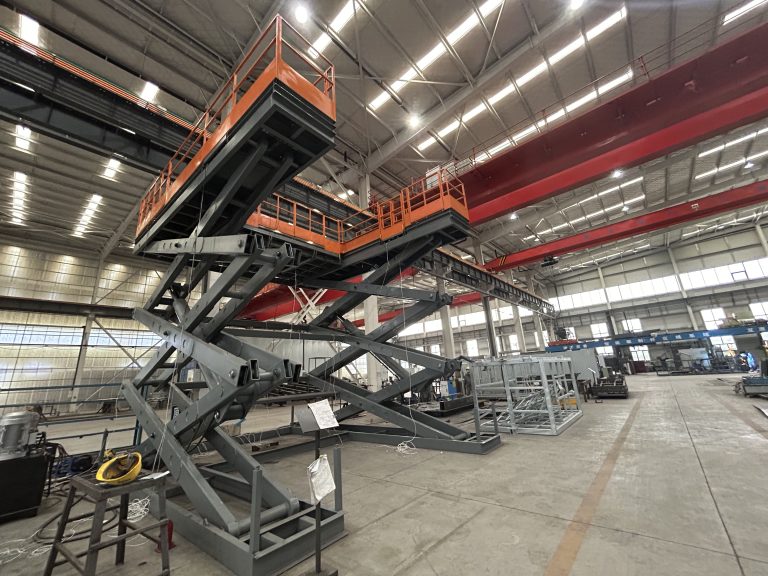
For a heavy manufacturing enterprise in Australia, we delivered a Custom Roller-Type Lift & Tilter, an integrated automated solution tailored for heavy-duty material handling and workshop process optimization. Replacing traditional separate lifting, flipping and manual conveying operations, this all-in-one equipment solves typical pain points including fragmented workflow, low positioning accuracy, frequent material damage and high labor consumption, greatly streamlining the client’s heavy material processing and assembly workflow.
1. Integrated Roller & Tilt Structural Customization
Traditional production requires independent equipment for lifting, turning and material feeding, resulting in repeated workpiece positioning, frequent transfer and long cycle intervals. This custom roller-type lift and tilter integrates powered roller conveying, precise height lifting and 90° hydraulic tilting into one compact unit. It realizes seamless docking between loading, height adjustment and angle reorientation, perfectly adapting to continuous heavy workpiece processing and line docking requirements of Australian industrial workshops.
2. Synchronized Operation Sharply Improves Productivity
Conventional segmented handling involves multiple transferring steps and manual calibration, causing low throughput and unstable production rhythm. The coordinated lifting, roller feeding and hydraulic tilting operation eliminates redundant intermediate procedures and idle waiting time. It supports uninterrupted cyclic processing of heavy workpieces and raises overall production efficiency by over 75%, effectively accelerating workshop processing, assembly and finished output.
3. Stable & Impact-Free Handling Achieves Zero Damage
Manual flipping and discrete equipment conversion easily cause workpiece offset, surface scratching, extrusion deformation and edge chipping, leading to high rework and rejection rates. The heavy-duty roller system ensures smooth, impact-free material feeding, while the balanced hydraulic tilting structure provides uniform stress distribution throughout the turnover process. It achieves zero surface damage and zero processing rework, stabilizing finished product quality and reducing material waste.
4. Great Labor Savings & Simplified Workflow
Traditional heavy material processing relies on multiple skilled workers for hoisting, positioning, conveying and angle correction, bringing high labor costs and human error risks. This automated integrated solution supports single-person independent operation. It simplifies complex handling procedures, eliminates efficiency fluctuations caused by manual operation differences, and maintains consistent high-frequency production output.
5. Heavy-Duty Design Compliant with Local Industrial Standards
Built for Australian heavy industrial working conditions, the equipment adopts thickened high-strength steel structure and wear-resistant industrial-grade components. Equipped with overload protection, hydraulic self-locking and emergency stop safety interlocks, it runs stably under long-term high-frequency heavy-load circulation. With high structural rigidity and low failure rate, it fully meets local workshop safety specifications and continuous production demands.
Beneficios generales del proyecto
After official commissioning and operation, the client’s heavy material processing efficiency increased by 75%+, with significantly reduced labor investment and zero quality defects. The entire handling and processing procedure achieved integrated, automated and standardized operation, effectively improving factory throughput, product qualification rate and overall market competitiveness.




 English
  Español de México
  Português do Brasil
  Русский
  العربية
  Türkçe
  ไทย
ไทย  Tiếng Việt
  Bahasa Indonesia
  Français
  Deutsch
  Polski
  Nederlands


